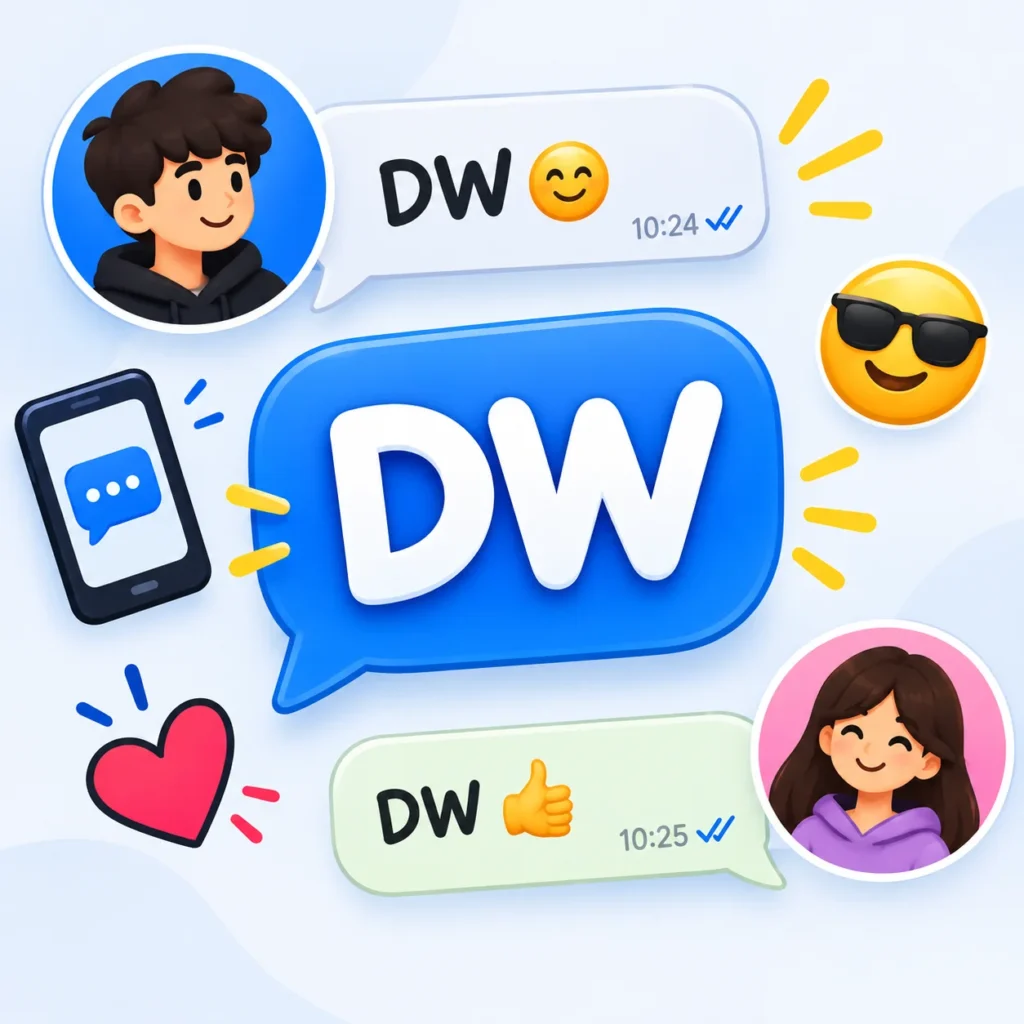
If you see “DW” in a text, DM, or social media conversation, it usually means “don’t worry.” This guide explains what DW means in chat, how people use it in different situations, what its tone can suggest, and how to respond naturally.
What Does DW Mean in Chat?
In most texting and online conversations, DW means “don’t worry.” It is a short way to reassure someone, tell them that something is not a problem, or let them know they do not need to feel concerned.
For example, if someone says, “Sorry I’m late,” a reply such as “DW!” means “Don’t worry!” The abbreviation makes the response quick and casual.
DW is especially common in informal conversations because texting often favors short expressions. You may encounter it in private messages, group chats, comments, gaming conversations, or conversations on social platforms.
The exact feeling behind DW depends on the surrounding message. It can sound warm and reassuring, neutral and practical, or very casual.
Why Do People Use DW in Texting?
It Saves Time
Typing “don’t worry” takes only a few extra characters, but DW makes the response even quicker. When people are having a fast conversation, abbreviations help keep messages short.
It Reassures Someone
DW is often used when another person apologizes, expresses concern, or thinks they have caused a problem.
For example:
- “Sorry, I forgot to send it.” — “DW.”
- “I might be a little late.” — “DW, take your time.”
- “I hope I didn’t bother you.” — “DW!”
In these situations, DW helps reduce unnecessary concern.
It Keeps the Conversation Casual
“Don’t worry” can sound slightly more formal depending on the context. DW has a distinctly casual texting style, making it suitable for relaxed conversations with friends, classmates, gaming partners, and other people you normally message informally.
Common Meanings of DW in Chat
Although “don’t worry” is the most common interpretation in ordinary texting, abbreviations can sometimes have different meanings depending on context.
DW = Don’t Worry
This is the standard meaning in casual chat.
Example:
“I accidentally deleted the message.”
“DW, it happens.”
Here, DW clearly means “don’t worry.”
DW as a Context-Dependent Abbreviation
Abbreviations can have multiple meanings in different communities or subjects. If DW appears in a technical, professional, gaming, or specialized conversation, you should consider the surrounding words before deciding what it means.
However, when someone simply sends “DW” during an everyday text conversation, “don’t worry” is generally the most natural interpretation.
How DW Can Sound in Different Situations
The same abbreviation can communicate slightly different tones depending on punctuation, wording, and context.
Friendly and Reassuring
“DW 😊” can feel warm and comforting.
Someone might use it when a friend is apologizing or feeling nervous.
Casual and Neutral
“DW, it’s fine” is straightforward and relaxed.
The sender is reassuring the other person without making the conversation overly emotional.
Brief or Dismissive
A message containing only “DW” can occasionally feel short. That does not automatically mean the sender is annoyed. Some people naturally use very brief texting styles.
If the rest of the conversation is friendly, DW is usually harmless. Context matters more than the abbreviation itself.
Examples of DW in Chat
Here are realistic examples showing how the abbreviation can be used:
- “Sorry I forgot to reply yesterday.” — “DW!”
- “I think I made a mistake.” — “DW, we can fix it.”
- “I’ll be five minutes late.” — “DW.”
- “Sorry for bothering you.” — “DW, you’re good.”
- “I didn’t mean to interrupt.” — “DW.”
- “I might not finish it tonight.” — “DW, tomorrow is fine.”
- “Sorry, I sent that to the wrong person.” — “DW 😂”
- “I hope you’re not upset.” — “DW, I’m not.”
- “Sorry I missed your call.” — “DW, call me when you can.”
- “I forgot to bring it.” — “DW, I’ll get another one.”
These examples show that DW usually works as a quick reassurance rather than as a complete explanation.
DW in Text Messages
In ordinary text messages, DW is commonly used between people who already have an informal relationship.
For example, a friend may say:
“Sorry, I can’t make it tonight.”
You could reply:
“DW, maybe next time.”
The abbreviation makes the response sound relaxed. If you are writing to someone in a formal setting, however, spelling out “don’t worry” may be more appropriate.
DW on Social Media
DW can also appear in comments, direct messages, and replies on social media platforms.
A person might respond to someone who is apologizing with:
“DW, no problem!”
Because social media conversations are generally informal, short abbreviations such as DW can fit naturally into the conversation.
The meaning remains dependent on context. If you are unsure, look at the words before and after DW rather than interpreting the abbreviation by itself.
DW in Group Chats
Group chats often contain fast-moving conversations, so abbreviations are particularly convenient.
Someone might write:
“Sorry everyone, I’m running late.”
Another member could answer:
“DW, we haven’t left yet.”
Here, DW reassures the person that their delay is not causing a problem.
In group conversations, punctuation and additional words can make the intended tone clearer. “DW!” can sound energetic and friendly, while “DW, it’s okay” sounds calmer.
DW From a Girl or Boy: Does It Mean Something Different?
Usually, DW does not have a special meaning based on whether the sender is a girl or a boy. If someone sends DW in a normal conversation, the most likely meaning is still “don’t worry.”
What matters more is the situation and the relationship between the people chatting.
For example, if someone apologizes and receives “DW 😊,” the message is probably intended as reassurance. If someone asks whether the other person is upset and receives “DW,” it can similarly mean that everything is okay.
Avoid reading too much into the abbreviation alone. The surrounding conversation provides much more information about the sender’s intention.
How to Respond When Someone Says DW
Your response can be simple because DW itself is usually a short reassurance.
If You Want to Acknowledge It
You can reply:
- “Okay, thanks!”
- “Got it.”
- “Thanks 😊”
- “I appreciate it.”
- “Alright!”
If You Want to Continue the Conversation
You can respond naturally and move on to the next topic.
For example:
“Thanks! Anyway, what time are you leaving?”
There is usually no need to give a long response to “DW.”
Naming and Styling Ideas for DW-Related Usernames
Because the target topic is a chat abbreviation rather than a clan, team, or username category, a large list of unrelated names would not match the search intent. Instead, if you want to create a username or social handle inspired by DW, you can build one around short, recognizable combinations.
Short and Simple
- DWDaily
- DWNotes
- DWChat
- DWVibes
- DWCorner
- DWSpace
- DWZone
- DWHub
- DWWorld
- DWSpot
Modern and Casual
- DWMode
- DWFlow
- DWWave
- DWLoop
- DWConnect
- DWTalk
- DWCircle
- DWThread
- DWLink
- DWSocial
Creative Combinations
- DigitalDW
- DWSignal
- DWOrbit
- DWCanvas
- DWPulse
- DWVerse
- DWNest
- DWStudio
- DWCloud
- DWLane
These are creative naming ideas rather than claims about existing popular or trending usernames.
How to Choose a Good DW-Based Username
Keep It Short and Memorable
Short combinations are generally easier to remember and type. If you are building a username around DW, avoid adding unnecessary words that make the handle difficult to recall.
Make It Easy to Spell
A simple spelling reduces the chance that someone will type your username incorrectly. Avoid excessive punctuation or complicated letter combinations unless they serve a clear purpose.
Use a Reusable Naming Formula
A simple formula can help generate original ideas without repeatedly copying the same structure.
Abbreviation + Noun
Examples:
- DWSpace
- DWCorner
- DWStudio
Abbreviation + Action
Examples:
- DWTalk
- DWConnect
- DWChat
Abbreviation + Concept
Examples:
- DWOrbit
- DWPulse
- DWVerse
These formulas can also be adapted to create a handle that matches your personal style.
Check Availability Before Using It
If you want to use a DW-based username on a particular website or social platform, check whether the exact handle is available before choosing it. Availability can differ between platforms, so a username that exists on one service may be available on another.
Read more: DHZ Meaning in Text: What Does DHZ Mean in Chat?
DW vs. Similar Texting Abbreviations
DW is one of many short expressions used in online communication. Knowing similar abbreviations can make chats easier to understand.
DW vs. NVM
DW means “don’t worry,” while NVM usually means “never mind.”
For example:
“Sorry about that.”
“DW.”
Compared with:
“Actually, forget it.”
“NVM.”
They serve different purposes even though both are common in casual texting.
DW vs. NP
NP commonly means “no problem.” It can overlap with DW in situations involving apologies.
For example:
“Sorry I’m late.”
“NP.”
This reassures the person that their lateness is not a problem.
DW vs. IDC
IDC usually means “I don’t care.” Unlike DW, it does not specifically reassure someone.
The difference is important because “DW” is generally intended to reduce concern, while “IDC” communicates a lack of concern or interest.
Frequently Asked Questions
What does DW mean in chat?
DW usually means “don’t worry.” It is commonly used in casual texts, DMs, group chats, and social media conversations to reassure someone.
What does DW mean from a girl?
When a girl sends DW in a normal texting conversation, it generally means “don’t worry.” The abbreviation itself does not automatically carry a romantic or hidden meaning.
What does DW mean from a guy?
A guy using DW in a casual conversation will usually mean “don’t worry.” The surrounding conversation is more important than the sender’s gender.
Is DW rude in texting?
DW is not inherently rude. It is normally a casual and reassuring abbreviation, although a message containing only “DW” may sometimes feel brief depending on the conversation and the relationship between the people involved.
What should I reply to DW?
A simple response such as “Thanks,” “Okay,” “Got it,” or “I appreciate it” works well. If you want to keep the conversation going, you can simply continue with your next message.
Does DW mean “don’t worry” on social media?
Yes, in ordinary social-media conversations, DW commonly means “don’t worry.” As with any abbreviation, context should be considered if the conversation is about a specialized subject.
What is the difference between DW and NVM?
DW means “don’t worry,” while NVM means “never mind.” DW reassures someone, whereas NVM is commonly used to withdraw a question, request, or previous thought.
Conclusion
DW in chat usually means “don’t worry.” It is a short, informal way to reassure someone after an apology, mistake, concern, or minor problem.
Quick Tips for Understanding DW
- Read the surrounding messages for context.
- Remember that DW usually means “don’t worry.”
- Do not assume the abbreviation has a romantic meaning.
- Consider the sender’s usual texting style.
- If the context is unclear, ask what they meant.