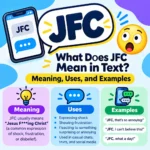
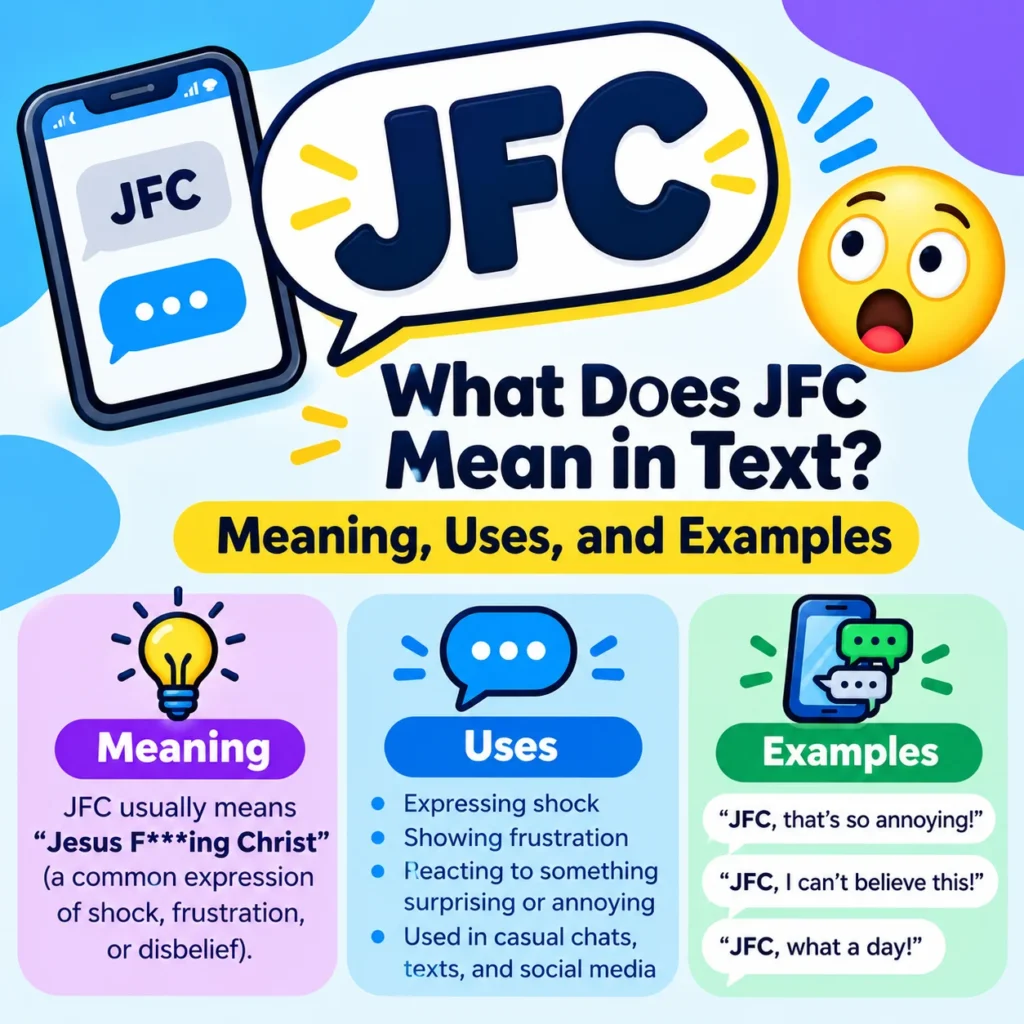
If you have seen “JFC” in a text, comment, or social media post, it usually means “Jesus f*ing Christ,”** an informal expression of strong surprise, frustration, disbelief, or annoyance. This guide explains what JFC means in texting, how people use it in different situations, whether it is offensive, and what alternatives you can use when you want a milder expression.
What Does JFC Mean in Text?
JFC is an internet and texting abbreviation for “Jesus f*ing Christ.”** It is generally used as an intensified reaction to something surprising, frustrating, shocking, ridiculous, or difficult to believe.
The expression is stronger than simply writing “Jesus Christ” because the added profanity emphasizes the speaker’s emotional reaction. Depending on the context, JFC can communicate anything from mild exasperation to strong disbelief.
For example, someone might use it after hearing unexpectedly bad news, seeing an outrageous price, dealing with a frustrating situation, or reacting to something impressive.
The exact emotion depends heavily on the surrounding message. JFC does not automatically mean anger. It can also communicate astonishment, disbelief, excitement, or exasperation.
Common Meanings of JFC
Although the abbreviation normally has one literal expansion, its practical meaning can vary according to context.
Surprise or Shock
Someone may use JFC when something catches them completely off guard. In this situation, it is similar to saying “Wow” or “Oh my goodness,” but with much stronger language.
The abbreviation can emphasize that the person did not expect what happened.
Frustration or Annoyance
JFC is also commonly used when someone is irritated by a situation. It can express the feeling of being overwhelmed or fed up.
For example, seeing a long delay, dealing with repeated problems, or encountering an annoying situation may prompt someone to use the abbreviation.
Disbelief
A person may write JFC when something seems unbelievable or excessive. This could involve an unexpected story, an unusually high price, or a surprising result.
In this context, it can be understood as a stronger version of “Seriously?” or “I can’t believe this.”
Amazement
JFC can sometimes express positive amazement rather than negativity. Someone who sees an exceptionally impressive performance, beautiful view, or unexpected achievement might use it to emphasize how strongly they reacted.
The surrounding words and punctuation usually make the intended emotion clearer.
How Is JFC Used in Texting?
JFC is usually informal and conversational. It is more appropriate for casual digital communication than professional or formal writing.
People may write it as a standalone reaction or place it at the beginning or middle of a sentence.
Common patterns include:
- JFC! — A strong reaction to something surprising or frustrating.
- JFC, that’s expensive. — Strong disbelief about a price.
- JFC, I can’t believe that happened. — Shock or disbelief.
- That was JFC-level stressful. — Informal emphasis on an extremely stressful situation.
- JFC, that’s impressive. — Strong amazement, potentially positive.
Capitalization is common because the abbreviation comes from three initial letters, but lowercase jfc is also understandable in casual texting.
Punctuation can also change the feel. “JFC!” sounds more forceful than “jfc…” which may suggest exhaustion, disbelief, or resignation.
Is JFC a Bad Word?
JFC contains profanity, so it is generally considered vulgar or potentially offensive language.
Whether it is inappropriate depends on the audience and setting. Friends may use it casually, while a workplace, classroom, customer-service conversation, or formal message may not be an appropriate place for it.
There is also a religious dimension because the phrase uses the name of Jesus Christ as an exclamation. Some people may therefore find the expression disrespectful or offensive for religious reasons.
If you do not know how the recipient feels about profanity or religious expressions, a milder alternative is safer.
When Should You Avoid Using JFC?
The abbreviation is best reserved for situations where informal language is clearly acceptable.
Consider avoiding it in:
- Professional emails
- Job applications
- School assignments
- Formal business messages
- Customer-service communication
- Messages to people you do not know well
- Religious or formal settings
- Situations where profanity could be misunderstood
Even when you personally use JFC casually, another person may interpret it as rude or disrespectful.
JFC vs. Similar Texting Abbreviations
Several abbreviations can communicate surprise, frustration, or disbelief, but their intensity and tone differ.
JFC vs. OMG
OMG means “Oh my God.” It can express surprise, excitement, shock, or disbelief.
JFC is generally more profane and forceful because it contains an additional swear word.
If someone wants to react strongly without using an explicit swear word, OMG is usually the milder choice.
JFC vs. WTF
WTF means “what the f***.” It is another profane abbreviation that commonly communicates confusion, shock, disbelief, or annoyance.
The two can overlap considerably. JFC often functions as an exclamation, while WTF can more directly question or react to something that seems strange.
JFC vs. SMH
SMH means “shaking my head.” It commonly communicates disappointment, disbelief, frustration, or disapproval.
SMH is generally less vulgar than JFC and can be used when someone wants to express frustration without profanity.
JFC vs. Seriously?
“Seriously?” is a much more neutral expression. It can communicate disbelief or annoyance without profanity or religious language.
If you are unsure whether JFC is appropriate, “Seriously?” is a straightforward alternative.
Is JFC Always Angry?
No. JFC does not necessarily indicate anger.
The abbreviation primarily signals strong emotion, and that emotion can be determined by context.
For example, a person might use it when they are:
- Shocked by unexpected news
- Annoyed by a difficult situation
- Amazed by an impressive achievement
- Frustrated by repeated problems
- Surprised by an unexpected cost
- Disbelieving something they just learned
Because the abbreviation is emotionally intense, readers generally look at the surrounding sentence to determine whether the reaction is positive, negative, or simply surprised.
JFC in Social Media
JFC can appear in social-media comments, captions, posts, group conversations, and private messages. Its informal nature makes it particularly suited to quick reactions.
On social media, people may use the abbreviation to emphasize an opinion or reaction without writing the entire phrase.
For example, a comment such as “JFC, that view is incredible” could indicate amazement rather than anger. In contrast, “JFC, this took forever” clearly communicates frustration.
Social-media context matters because the same abbreviation can have different emotional meanings depending on the subject.
JFC in Gaming and Online Communities
Players and members of online communities may use JFC as a quick reaction during conversations about games, competitions, updates, technical problems, or surprising events.
For example, someone might use it when a match takes an unexpected turn or when a difficult challenge takes much longer than expected.
However, community standards vary. Some gaming servers, forums, workplaces, and moderated communities may restrict profanity or have rules governing language.
When participating in a new online community, it is sensible to follow the community’s stated communication rules rather than assuming every informal abbreviation is acceptable.
Polite Alternatives to JFC
If you want to express the same general emotion without profanity, several alternatives work well.
Mild Alternatives
These options can communicate surprise or frustration without strong language:
- Wow
- Oh wow
- Seriously?
- Goodness
- Oh my goodness
- That’s unbelievable
- I can’t believe it
- What in the world?
- No way
- That’s wild
- Wow, seriously?
- Are you kidding me?
- That’s crazy
- Unbelievable
- Oh man
The best alternative depends on the emotion you want to communicate.
Strong but Non-Profane Alternatives
If “wow” feels too weak, you can still emphasize your reaction without using profanity:
- That is absolutely unbelievable.
- I seriously cannot believe this.
- What on earth just happened?
- That is incredibly frustrating.
- This is completely ridiculous.
- I am genuinely shocked.
- That is seriously impressive.
These expressions are easier to use in mixed or uncertain audiences.
Read more: ASf Сленг: What Does ASF Mean in Texting and Social Media?
How to Understand JFC in a Message
When you encounter JFC in a text, do not interpret the abbreviation by itself. Look at the words surrounding it and the subject of the conversation.
Consider these factors:
- What happened immediately before it?
This often reveals whether the person is surprised, angry, amused, or impressed. - What words follow JFC?
A phrase such as “that’s expensive” suggests disbelief or frustration, while “that’s amazing” suggests admiration. - What punctuation is used?
An exclamation mark can increase intensity, while an ellipsis can make the expression feel tired or resigned. - Who sent it?
A close friend may use profanity casually, while a coworker may be using it in a more emotionally charged way. - What is the overall conversation like?
Context is often more useful than the abbreviation alone.
Common Questions About JFC
What does JFC stand for in texting?
JFC usually stands for “Jesus f*ing Christ.”** It is an informal, profane expression used to show strong surprise, frustration, disbelief, annoyance, or amazement.
What does JFC mean from a girl?
JFC has the same basic meaning regardless of whether the sender is a girl or a boy. The specific emotion depends on what she is responding to and the surrounding conversation.
What does JFC mean from a guy?
When a guy uses JFC, it generally indicates a strong emotional reaction. It may express surprise, frustration, disbelief, or amazement rather than having a special gender-specific meaning.
Is JFC rude?
It can be. JFC contains profanity and references a religious figure, so some people may consider it offensive or disrespectful. In casual conversations it may be accepted, but it is generally better avoided in formal or sensitive settings.
Is JFC the same as WTF?
Not exactly, although they can be used in similar situations. Both are profane reactions to surprise, confusion, frustration, or disbelief, but JFC is an exclamation based on “Jesus fing Christ,” while WTF is based on “what the f.”
What is a polite alternative to JFC?
Good alternatives include “wow,” “seriously?”, “oh my goodness,” “that’s unbelievable,” “what on earth?”, and “I can’t believe it.” The right choice depends on whether you want to communicate surprise, frustration, or amazement.
Does JFC always mean something negative?
No. JFC can express positive amazement as well as frustration or shock. For example, someone might use it when reacting to an exceptionally impressive performance or an amazing view.
Conclusion
JFC is a common informal abbreviation for “Jesus f*ing Christ,”** usually used to express a strong reaction such as surprise, frustration, disbelief, or amazement. Because it contains profanity and a religious reference, its appropriateness depends on the audience and setting.
Quick Tips for Understanding and Using JFC
- Read the surrounding message before deciding what emotion it expresses.
- Remember that JFC is informal and contains profanity.
- Avoid it in professional, academic, or sensitive communication.
- Use alternatives such as “wow,” “seriously?”, or “oh my goodness” when you want a cleaner expression.
- Pay attention to punctuation and context because they can change the tone.