
Have you ever scrolled through a text thread or social media comment section and felt like you needed a translator?
Language is shifting faster than ever, and keeping up can feel like a full-time job.
One abbreviation that frequently trips people up is “asl,” leaving many wondering if they are missing a crucial piece of the conversation.
If you have stumbled across this term and found yourself confused, you are definitely not alone.
Depending on who you are texting, this tiny three-letter acronym can mean completely different things.
Let’s break down the layers of this digital linguistic puzzle so you can text with absolute confidence.
Understanding the Hidden Shift: Why is Everyone Searching for This?
The digital world has a fascinating way of recycling old terms and giving them entirely new lives.
For decades, certain acronyms had fixed meanings, but the rise of younger generations on platforms like TikTok and Instagram has rewritten the rules.
People are searching for the meaning of this term because they are encountering it in wildly different contexts.
An older texter might see it and think of early internet chat rooms, while a younger smartphone user sees it as a way to add emphasis to their feelings.
This clash of generational slang is precisely where the confusion begins.
If you interpret the term through the wrong cultural lens, a harmless text message can suddenly seem incredibly awkward or invasive.
By understanding the modern landscape of digital speech, we can bridge this communication gap effortlessly.
ASL – Quick Meaning
To put it simply, the abbreviation has two primary dominant meanings in the texting world, alongside one major formal usage.
- Modern Slang Meaning: It stands for “as hell.”
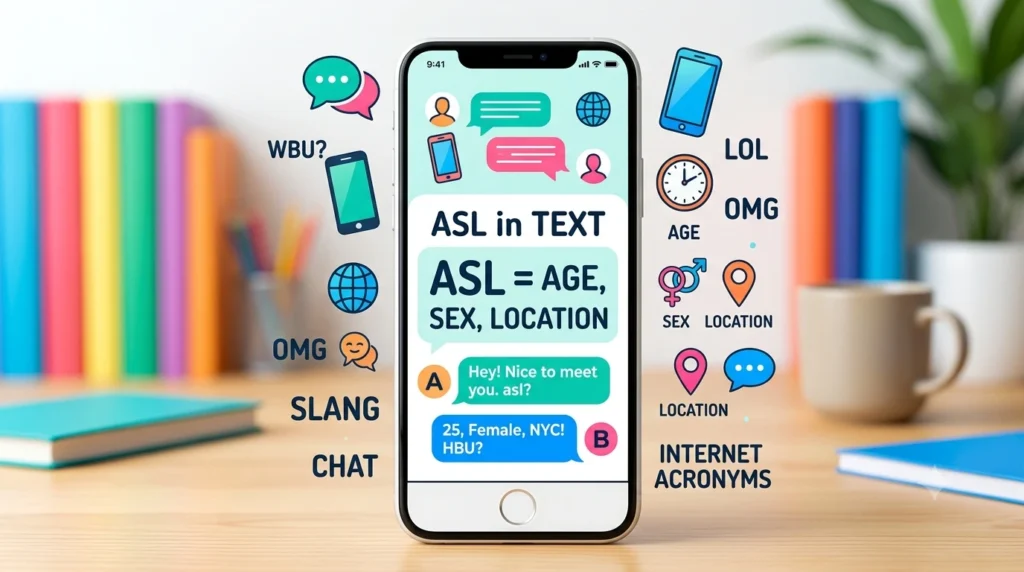
- Classic Internet Meaning: It stands for “Age, Sex, Location.”
- Formal/Linguistic Meaning: It stands for American Sign Language.
To help you see how these function in daily life, consider these quick examples:
“This test was hard asl, I don’t think I passed.” (Meaning: “as hell”)
“Hey, new here! 19/M/NY. What is your asl?” (Meaning: “Age, Sex, Location”)
“I am currently taking a college course to learn ASL.” (Meaning: “American Sign Language”)
Origin & Background
To truly understand how we got here, we have to travel back to the early days of the consumer internet.
During the late 1990s and early 2000s, the web was dominated by anonymous chat rooms like AOL Instant Messenger (AIM) and IRC.
When you entered a chat room, nobody knew who you were, so the standard greeting to start a conversation was “a/s/l” or “asl.”
This was a quick, functional way to screen who you were talking to before spending time in a deep conversation.
As social media platforms evolved and profiles began displaying real names, photos, and locations automatically, this classic query largely faded into the background.
The Modern Social Media Renaissance
Fast forward to the late 2010s and early 2020s, and the term underwent a massive phonetic evolution.
On platforms like Twitter, TikTok, and Instagram, users began typing “asl” as a phonetic shortcut for “as hell.”
This shift is deeply rooted in African American Vernacular English (AAVE), where the pronunciation of “as hell” often flows quickly, sounding exactly like “as-l.”
Rather than typing out two separate words, fast-fingered mobile users consolidated the sound into three simple letters.
Real-Life Conversations
Seeing this slang in action is the easiest way to master its usage and avoid awkward misunderstandings.
WhatsApp (The Generational Misunderstanding)
Person A: “Hey! We haven’t talked in forever. What is your asl these days?”
Person B: “Wait, what? Why are you asking for my age and location? We went to high school together!”
Person A: “Oh my gosh, no! I meant I missed you asl! I wanted to catch up!”
Instagram DMs (Modern Hype)
Person A: “Did you see the outfit she wore to the concert last night?”
Person B: “Yes! She looked pretty asl, honestly. I need to know where she got that jacket.”
Person A: “Right?! I am looking for it online right now.”
TikTok Comments (Expressing Mood)
Person A: “Watching this video at 3 AM while trying not to wake up my roommates.”
Person B: “Lmao same, I am tired asl but I can’t stop scrolling.”
Text Messages (The Group Chat Plan)
Person A: “Are we still on for pizza tonight? I am hungry asl.”
Person B: “Yeah, leaving my house in ten minutes. See you there!”
Emotional & Psychological Meaning
Linguistics is never just about the literal definitions of words; it is about the emotional weight they carry.
When someone uses the modern version of this abbreviation, they are usually looking for a quick way to amplify their emotional state.
It acts as an intensifier, serving a similar psychological purpose to using all caps or adding multiple exclamation marks to a sentence.
In the fast-paced world of digital communication, we often feel that plain text lacks warmth and intensity.
Using this slang allows a speaker to project their real-life voice, tone, and emphasis through a flat screen.
It signals to the receiver that the sender is speaking casually, comfortably, and without the rigid barriers of formal writing.
A Lesson from the Classroom
During my years working with young adults, I recall a student who came to me quite upset about a text from a peer.
The text read, “Your presentation was long asl.”
The student initially thought they were being asked for personal details in an inappropriate way.
Once we sat down and I explained that the peer was simply saying the presentation was “long as hell,” the anxiety melted away instantly into a shared laugh.
It was a powerful reminder of how digital shorthand can deeply impact our emotional state when we lack the proper context.
Usage in Different Contexts
Navigating when to use this abbreviation is key to keeping your digital reputation intact.
Social Media
On platforms like TikTok, X (formerly Twitter), and Instagram, using the modern slang version is incredibly common.
It fits perfectly into short captions, rapid-fire comments, and casual video overlays where space is limited and speed is everything.
Friends & Relationships
In close personal circles, using this slang creates a sense of casual intimacy and shared cultural understanding.
It shows that you are relaxed and not overthinking your sentence structure around them.
Work & Professional Settings
You should absolutely avoid using this term in professional emails, Slack channels, or LinkedIn messages.
Using “asl” in a workplace context will almost certainly be viewed as unprofessional, and it could easily be misinterpreted as the outdated, invasive “Age, Sex, Location” query.
Casual vs. Serious Tone
Keep in mind that this slang is purely casual.
If you are having a serious, emotional, or sensitive conversation with someone, dropping this abbreviation can make you seem dismissive or insincere.
When NOT to Use It
While slang is a fun way to connect, there are several boundaries you should respect.
- With Authority Figures: Do not send this to boss, teachers, or clients.
- In High-Stakes Situations: Avoid using it when discussing serious issues, medical updates, or emergencies.
- With Non-Native English Speakers: Slang does not always translate well, and this phonetic abbreviation can confuse those who are still mastering standard English.
- When Discussing Sign Language Communities: If you are talking to someone in the Deaf community, using the lowercase slang version of “asl” carelessly can sometimes feel disrespectful to the rich history of American Sign Language.
Common Misunderstandings
The absolute biggest hurdle with this term is tone and context confusion.
Because the letters can stand for three entirely different concepts, users frequently talk past one another.
                           [ ASL ]
                              │
         ┌────────────────────┼────────────────────┐
         ▼                    ▼                    ▼
   "As Hell"           "Age/Sex/Loc"        Sign Language
 (Modern Slang)        (Retro Chats)        (Deaf Culture)
Many people from older generations still associate these letters with the sketchy chat rooms of the early internet.
Consequently, when a younger person texts them saying, “I am busy asl,” the older recipient might feel uncomfortable, thinking they are being asked for personal demographic information.
Conversely, younger users might have no idea that the “Age, Sex, Location” meaning ever existed.
Understanding these differences is key to preventing unnecessary tension in your digital interactions.
Slang Comparison Table
| Term | Modern Slang Meaning | Classic Meaning | Context Level |
| ASL | As hell (intensifier) | Age, Sex, Location | Very Casual / Texting |
| AF | As f*** (extreme intensifier) | None | Edgy / Casual |
| FR | For real (agreement/truth) | None | Casual / Expressive |
| A/S/L | Rarely used today | Age, Sex, Location | Retro Internet / Chatrooms |
Key Insight
While many slang terms focus on replacing nouns or verbs, terms like “asl” and “af” serve as modern grammatical intensifiers, taking the place of traditional adverbs like “extremely” or “incredibly.”
To dive deeper into how digital expressions and names carry hidden meanings across different cultures, you can explore the insights over at Name Meaning Zone, where language and identity intersect.
Variations & Types
To help you stay ahead of the curve, here are ten common variations and related digital expressions you will likely see online:
- asl (all lowercase): The standard modern slang for “as hell.”
- A/S/L or a/s/l: The classic chatroom format asking for personal details.
- ASL (all uppercase): Usually refers directly to American Sign Language.
- mad asl: Extremely or incredibly, as in “I’m mad asl at this traffic.”
- funny asl: Something that is absolutely hilarious.
- tired asl: Feeling completely exhausted or drained.
- cute asl: High praise for someone’s appearance or a charming object.
- annoying asl: Expressing high frustration with a situation or person.
- expensive asl: Complaining about the high cost of an item or service.
How to Respond When Someone Uses It
Your response should always match the context of the conversation.
Here are a few ways to handle it smoothly depending on the vibe you want to project.
Casual Replies
- “I know, right?
- “Fr, I couldn’t agree more.”
Funny Replies
- “Asl? I’m 100 years old, a wizard, and currently residing in Narnia.” (A great way to tease someone who might be using the retro meaning).
- “Honestly, same. My couch is calling my name.”
Mature Replies
- “I completely understand why you feel that way.”
- “That sounds really intense, let me know if you need any help.”
Respectful Replies
- “Thank you for letting me know, I appreciate the update.”
- “I will keep that in mind for next time.”
Regional & Cultural Usage
The way people use and understand this term varies wildly depending on where they are in the world and their age group.
Western Culture
In the United States, Canada, and the United Kingdom, the modern slang meaning has taken a firm hold among Gen Z and younger Millennials.
It is a staple of urban digital dialects and online creator spaces.
Asian & Middle Eastern Cultures
In regions where English is a second language, the modern slang meaning is far less common.
In these areas, if the term is recognized at all, it is typically understood either as American Sign Language or through its classic chatroom definition.
Generational Differences
The division between generations is incredibly stark here.
According to linguistic studies compiled by Merriam-Webster, phonetic spelling shifts are heavily driven by mobile-first generations.
Millennials and Gen X are much more likely to remember the privacy-invasive chatroom days, while Gen Z and Gen Alpha view the term purely as a tool for text emphasis.
Is It Safe for Kids?
As a parent or educator, seeing your child use this abbreviation might trigger some immediate red flags.
If they are using it in a sentence like “this game is fun asl,” they are simply using modern slang for “as hell.”
While it does contain a mild curse word derivative, it is generally harmless social chatter.
However, if you notice your child receiving messages that simply say “asl?” or “a/s/l?” from unknown accounts, this is a sign of caution.
This indicates that a stranger may be trying to solicit their age, sex, and physical location.
Teaching children the difference between these two usages is a highly effective way to keep them safe online.
FAQs
What does “asl” mean on TikTok?
On TikTok, it almost always means “as hell.” Creators and commenters use it to add dramatic emphasis to their captions and video reactions.
Is “asl” a bad word?
It is not a severe curse word, but because it stands for “as hell,” some people find it mildly inappropriate. It is best to avoid using it in formal, polite, or professional settings.
How do I know if someone means “Age, Sex, Location” or “As Hell”?
Look closely at the grammar of the sentence. If it is used as a question on its own (“asl?”), they are asking for personal details. If it is placed at the very end of a descriptive sentence (“I’m tired asl”), they mean “as hell.”
When did “asl” start meaning “as hell”?
The shift began gaining mainstream traction around 2018 and 2019 on platforms like Twitter, heavily influenced by phonetic writing patterns in digital AAVE.
Why do people type “asl” instead of “as hell”?
It is purely a matter of speed, convenience, and matching the phonetic rhythm of natural, casual speech.
Final Thought
At the end of the day, language is a living, breathing thing that evolves to fit our daily needs.
Whether you choose to adopt this slang into your own vocabulary or simply want to understand it when it pops up on your screen, you now have the tools to navigate these digital conversations with ease.
Do not be afraid of the shifting tides of modern text speech—embrace the learning process, keep communicating, and text with confidence!