Have you ever scrolled through your social media feed, opened a text message, or checked a comment section only to spot the letters “TF” and feel a bit out of the loop? You are certainly not alone in that feeling.
In our fast-paced digital world, internet slang evolves faster than most of us can keep up with. Abbreviations pop up daily, transforming how we express emotion, react to news, and communicate with friends across the globe.
Understanding these short digital expressions is no longer just about knowing slang; it is about staying connected to modern human culture. Let us break down exactly what “TF” means, where it comes from, and how you can use it naturally without any awkward missteps.
Unpacking the Mystery Behind “TF”
Modern digital communication relies heavily on speed and emotional efficiency. When something sudden or shocking happens, typing out a full sentence often feels too slow to match what we are feeling in the moment.
That is precisely why short, high-impact slang terms like “TF” exist. They act as instant emotional shortcuts, letting the other person know immediately that you are surprised, confused, or utterly disbelief-ridden.
       [ Sudden Shock / Confusion ]
                    │
                    ▼
     [ "TF" (Emotional Shortcut) ]
                    │
          ┌─────────┴─────────┐
          ▼                   ▼
[ Loud Disbelief ]    [ Quiet Curiosity ]
By decoding these short acronyms, you clear up screen-time confusion and gain a deeper peak into how younger generations process emotions online.
What Does TF Mean? Quick Meaning
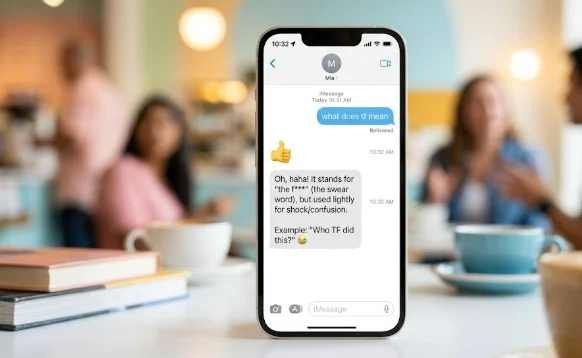
At its core, TF stands for “The F*” (a censored version of the well-known profanity). It is a direct abbreviation used to emphasize extreme shock, deep confusion, frustration, or total disbelief.
Depending on the context and punctuation, its intensity can range from lighthearted banter to intense irritation.
- “TF just happened?”
- “Who TF left the door open?”
- “Wait, TF? Are you serious right now?”
Origin and Background of the Term
Where It Came From
The expression itself originates from casual spoken English, where adding an explicit modifier to “what,” “who,” “where,” or “how” adds strong emotional emphasis.
Cultural Influence and Evolution
Over time, this shorthand migrated from niche gaming forums and instant messaging apps into mainstream culture.
Pop culture, hip-hop music, and online meme culture accelerated its adoption globally, transforming it from vulgar street slang into a universally understood piece of internet shorthand.
Social Media Impact
Platforms like Twitter, TikTok, and Instagram helped solidify “TF” in everyday digital vocabularies.
On video-centric platforms, creators frequently use the abbreviation in text overlays and captions to capture a viewer’s immediate curiosity within the first few seconds of a video.
Real-Life Conversations
To really grasp how this slang works in the wild, let us look at some realistic exchanges across different popular platforms.
WhatsApp Text Exchange
Person A: I just saw an elephant walking down Main Street!
Person B: TF? Send a photo right now, you have to be lying!
Instagram DM
Person A: Did you see that Marcus deleted all his posts overnight?
Person B: Wait, TF why would he do that? Everything was fine yesterday.
TikTok Comment Section
Person A: This recipe calls for three whole cups of salt.
Person B: 3 cups?! What TF is this creator thinking?
Emotional and Psychological Meaning
Behind those two simple letters lies a powerful psychological need: the desire to convey raw, unfiltered emotional presence through a cold glass screen.
When we type standard text, tone of voice and body language get lost completely. Using an intense abbreviation signals to the reader that your reaction is intense, sudden, and genuine.
Field Notes: During a live digital strategy session last year, a client received a sudden notification that their site traffic spiked by 400%. Without thinking, the young project assistant blurted out, “Wait, TF?” The room went brief silent, but it perfectly captured the collective shock everyone felt. That moment highlighted how deeply embedded these raw emotional triggers have become in our daily reactions.
Usage in Different Contexts
Social Media Platforms
On public platforms, people use it to react to viral news, bizarre videos, or shocking celebrity gossip. It functions as an immediate digital double-take.
Friends and Casual Relationships
Among close peers, the term is frequently used playfully. It adds dramatic flair to everyday minor inconveniences or funny stories.
Work and Professional Settings
It is best to strictly avoid using this slang in professional emails, client communications, or formal workplace chats like Slack or Teams.
When NOT to Use It
While common, this abbreviation contains implied profanity, making it sensitive in many scenarios.
- Formal business or academic correspondence
- Conversations with elders or figures of authority
- Sensitive support or grief-related conversations
- Professional networking outreach
Common Misunderstandings
Tone Confusion
Because text lacks vocal pitch, some people mistake a playful use of the slang for real anger or hostility.
Literal vs. Figurative Meaning
New internet users sometimes take the phrase literally, assuming the speaker is genuinely angry, when in reality they are just mildly amused or surprised.
Comparison Table
| Slang Term | Full Meaning | Primary Emotion | Tone Level |
| TF | The F*** | Shock / Frustration | Moderate to Strong |
| WTF | What The F*** | Complete Disbelief | Strong |
| WTH | What The Hell | Mild Surprise | Soft / Moderated |
| TBH | To Be Honest | Sincerity / Directness | Neutral |
Key Insight
Choosing between these variations usually comes down to your personal comfort with informal language and how well you know the person receiving your message.
Variations and Types of “TF” Expressions
WTF (What The F***)
The extended, classic version used for maximum surprise or profound confusion.
WTF-Isms
A general category of creative spin-offs adapted for specific comedic situations online.
HTF (How The F***)
Used specifically when asking how an unbelievable or chaotic event was physically possible.
WTF-Ever
A dismissive variation combining shock with total apathy toward a situation.
WTF-O
An older military or technical variant used to signal extreme operational confusion.
WTF-Ness
A noun variation used to describe a general state of chaos or confusing weirdness.
WTF-Moment
Refers to a specific event or situation that leaves everyone involved completely speechless.
WTF-Face
Describes the physical facial expression of utter confusion someone makes in real life.
How to Respond When Someone Uses It
               [ Someone Sends "TF?" ]
                          │
       ┌──────────────────┼──────────────────┐
       ▼                  ▼                  ▼
 [ Casual Tone ]    [ Funny Tone ]    [ Mature Tone ]
  "I know, right?"   "Expect the       "Let me break
                      unexpected!"      it down..."
Casual Replies
- “I know, right? Totally wild.”
- “Right?! I couldn’t believe it either.”
Funny Replies
- “Hey, don’t ask me, I just live here!”
- “Expect the unexpected around here.”
Mature Replies
- “I realize it sounds strange. Let me explain the full context.”
- “It is definitely surprising, but there is a reasonable explanation.”
Respectful Replies
- “I understand your confusion. Here is what actually happened.”
- “Fair reaction! Let me clear that up for you.”
Regional and Cultural Usage
Western Culture
In North America and Western Europe, the abbreviation is widely recognized across nearly all age demographics under 40.
Asian Culture
In Asian digital spaces, English slang like this is often adopted by younger, bilingual internet users, though localized native acronyms remain far more common.
Middle Eastern Culture
Usage is generally restricted to Westernized youth culture and English-speaking gaming communities, often moderated to avoid offense.
Global Internet Culture
Gamers, tech enthusiasts, and social media creators worldwide use the phrase as a universal reaction language regardless of their native tongue.
Generational Differences
Gen Z uses the slang seamlessly and casually, whereas Millennials tend to reserve it for genuine shock or exaggerated humor.
To explore how other modern terms and names carry unique emotional weight across different cultures, check out Name Meaning Zone for detailed cultural breakdowns.
Is It Safe for Kids?
Because the acronym represents an explicit swear word, it is generally considered inappropriate for young children.
Parents should be aware that while kids may see it frequently in online video comment sections, it carries an underlying vulgarity that is unsuitable for formal or young child settings.
If you are interested in modern digital safety and guidelines for web interactions, review official resources on Google Search Quality Guidelines to understand modern digital communication standards.
Frequently Asked Questions
What does TF stand for in text messages?
It almost always stands for “The F***,” used to express intense surprise, shock, or confusion in casual conversations.
Is TF considered a bad word?
While the two-letter acronym itself isn’t a direct profanity, it represents a swear word, so it should be avoided in polite or professional settings.
What is the difference between WTF and TF?
“WTF” includes the word “What” at the beginning, whereas “TF” is often tacked onto the end of questions like “Who TF?” or “Why TF?”
Can TF mean anything else?
In niche context like science or finance, it can stand for “Transform Function” or “Trust Fund,” but in text messaging, it almost exclusively means the slang term.
Is TF rude to use with friends?
Not usually! Among close friends, it is typically viewed as playful exaggeration or genuine shared shock rather than rudeness.
Final Thoughts
Language is a living, breathing thing that adapts alongside our technology. Slang terms like “TF” are not ruining language; they are simply modern tools helping us convey human emotion across digital devices.
Understanding these terms empowers you to navigate internet culture with confidence and clarity. Use it casually, keep context in mind, and never be afraid to ask when a new acronym pops up on your screen!