We have all been there. You are staring at your phone, scrolling through a fast-paced group chat, and someone drops a three-letter acronym that stops you in your tracks. Modern digital communication moves at the speed of light, and linguistic shorthand evolves faster than dictionaries can keep up.
If you have spotted the term “IMA” in a text message, Instagram DM, or TikTok comment, you might find yourself wondering about its exact meaning. Is it an acronym, a typo, or a phonetic blend? Misinterpreting digital shorthand can completely shift the tone of a conversation, sometimes leading to awkward misunderstandings.
Understanding this specific slang term is not just about keeping up with trends. It is about genuinely connecting with the people on the other side of the screen. Let us demystify this common expression and explore how it functions in modern conversations.
“IMA” – Quick Meaning
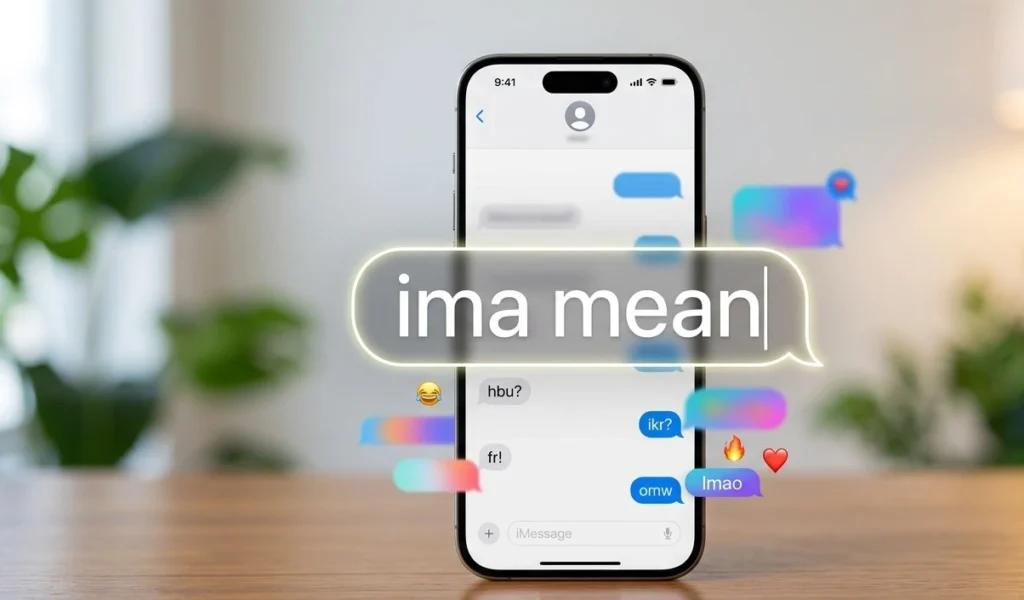
At its core, IMA (most commonly written as ima or Imma) is a phonetic representation of the spoken phrase “I’m gonna” or “I am going to.” It functions as a future-tense verbal contraction used to announce an immediate or upcoming action.
- Primary Definition: A casual contraction meaning “I am going to” or “I’m about to.”
- Grammatical Function: It replaces the subject and auxiliary verb combination to streamline a sentence.
- Intended Tone: Informally decisive, relaxed, and action-oriented.
Here are a few classic examples of how it looks in everyday typing:
“Ima pull up to your house in ten minutes, make sure you are ready.”
“If they don’t fix this Wi-Fi connection soon, ima lose my mind.”
“Ima head to bed early tonight because my morning shift is brutal.”
Origin & Background
The term does not originate from internet culture itself, but rather from spoken language. It is a direct phonetic spelling of African American Vernacular English (AAVE), where “I’m going to” naturally blends into “Imma” during fluid speech.
From Spoken Word to Digital Text
Before smartphones existed, people spoke this contraction daily. When mobile texting and early internet chat rooms gained popularity in the late 1990s and early 2000s, character limits forced users to type efficiently.
Linguists note that typing phonetically allowed users to preserve their natural spoken voice in text form. Dropping the double ‘m’ to create “ima” made typing even faster on old T9 cell phone keypads.
Social Media Amplification
With the rise of Twitter, Vine, and eventually TikTok, regional dialects transformed into global internet slang. Hip-hop lyrics and viral memes pushed the term into mainstream global consciousness. Today, it transcends its original geographical boundaries, serving as a staple of digital communication worldwide.
Real-Life Conversations
To truly see how this slang functions, let us look at some authentic scenarios across different platforms. Notice how it sets a casual, immediate tone.
WhatsApp Group Chat
jerry : Are we still meeting up at the food court by 6:00 PM?
tom : Yeah, traffic is terrible though.
jerry : Ima be a few minutes late, don’t order without me!
tom : All good, we will wait by the entrance.
Instagram DM
Person A: That sneaker drop is happening in five minutes. Are you buying them?
Person B: Honestly, ima try my luck. They look too clean to pass up.
Person A: Good luck, the site is probably going to crash.
TikTok Comments Section
Person A: This recipe looks incredible but why is the cheese so expensive? 😭
Person B: Fr, ima need a second job just to buy the ingredients.
Casual Text Message
Person A: Did you finish studying for the history midterm yet?
Person B: Not even close. Ima finish this chapter and then take a massive nap.
Emotional & Psychological Meaning
Using this shorthand carries psychological weight that goes beyond mere laziness in typing. When someone types this word, they are deliberately choosing an informal, intimate register.
A Sense of Immediacy and Intent
The word conveys a distinct feeling of current momentum. Saying “I am going to do that” feels structured, formal, and distant. Typing “ima do that” implies the action is already set in motion, or that the speaker is reacting purely on impulse.
Fostering Digital Closeness
Slang acts as a social shortcut. By adopting a relaxed linguistic style, the sender signals to the recipient that they feel completely comfortable around them. It strips away the rigid barriers of formal grammar to create a space of mutual warmth and shared subculture.
A Personal Perspective on Tone
During a busy week, a close colleague texted me, “Ima grab coffee, want anything?” That single word instantly shifted the dynamic from a sterile work interaction to a comforting, friendly moment. It showed me that linguistic shortcuts can build quick bonds even during stressful moments.
Usage in Different Contexts
Context changes everything when it comes to text-based communication. Here is how the term adapts to various social spaces.
Social Media Platforms
On platforms like TikTok, X, and Instagram, brevity is essential. Users utilize the term in captions, video overlays, and comments to keep their text concise and punchy. It keeps the energy lively and youthful.
Friends & Relationships
This is where the term lives naturally. Between close friends or romantic partners, it signals comfort. It allows you to announce your daily updates without making your texts sound like a series of stiff, formal emails.
Work and Professional Settings
This word should generally be avoided in professional environments. Using it in a corporate email or a message to a client can make you look unprofessional or overly detached. Stick to standard phrasing like “I will” or “I am planning to” when speaking with superiors.
Casual vs. Serious Tone
The term is inherently casual. However, it can be used seriously if someone is expressing strong, immediate boundaries or frustration. For example, typing “Ima leave if you keep playing” shows that a casual term can carry real weight when necessary.
When NOT to Use It
While this slang term is highly versatile, it is vital to know when to leave it out of your vocabulary entirely.
- Formal Academic Writing: Never include this term in essays, research papers, or applications.
- In Times of Serious Crisis: If you are handling a delicate situation or offering deep condolences, utilizing casual slang can seem insensitive or emotionally detached.
- Communicating with Elders: Older generations who are unfamiliar with internet culture might find the phrase confusing or interpret it as broken English.
- Initial Job Outreach: First impressions matter immensely, so keep your language polished until you understand the workplace culture.
Common Misunderstandings
Because text messages lack facial expressions and vocal inflections, misunderstandings happen frequently.
The Capitalization Confusion
Sometimes people mistake “IMA” for an official organizational acronym. In corporate settings, it often stands for the Institute of Management Accountants. If someone sees the word in an ambiguous sentence, they might wonder if you are referring to a professional credential rather than making a statement about your plans.
The Typo Assumption
Grammar purists occasionally mistake the slang for a typo of the word “Iam” or an accidental press of the keyboard. This can lead to unnecessary corrections that disrupt the natural flow of a friendly conversation.
Comparing Modern Text Slang
To clarify how this word fits into the wider world of digital communication, let us compare it with similar terms.
| Term | Meaning | Tone | Best Used For |
| IMA | I am going to | Casual, Action-oriented | Announcing immediate plans |
| IKR | I know, right? | Agreeable, Empathetic | Validating someone’s opinion |
| BRB | Be right back | Informative, Brief | Pausing a live conversation |
| RN | Right now | Urgent, Present-focused | Emphasizing current status |
| FINNA | Fixing to / Preparing to | Casual, Dialect-driven | Expressing intent to act soon |
Key Insight
While terms like BRB and RN focus entirely on time management, IMA bridges the gap between intent and action, making it a highly proactive slang choice.
Variations & Types
Depending on the region, platform, and individual typing style, this expression can take several distinct forms.
- Imma: The traditional, phonetically accurate spelling that clearly represents spoken dialect.
- Ima: The highly streamlined, character-saving version popular in quick text messages.
- i’ma: A punctuated version that attempts to bridge standard grammar rules with slang.
- Imma bout to: A double contraction used to emphasize that an action is happening in the next few seconds.
- Ima try to: Used when someone wants to show intent but cannot fully guarantee success.
- Ima need: A common phrase used to demand or request something in a humorous, direct way.
- Imma head out: A classic internet meme phrase used to announce a departure from a physical place or an awkward conversation.
- Ima keep it real: An introductory phrase used right before sharing an honest, unfiltered opinion.
How to Respond When Someone Uses It
Your response depends entirely on the energy of the conversation. Match the vibe of the sender using these different approaches.
Casual Responses
- “Sounds good, see you when you get here!”
- “Bet, let me know how it goes.”
- “Cool, I’ll be waiting.”
Funny Responses
- “Don’t do anything I wouldn’t do! 😂”
- “Ima need you to hurry up, I’m starving.”
- “Famous last words right there!”
Mature Responses
- “Take your time, safety comes first.”
- “Understood, keep me updated on your progress.”
- “I appreciate you letting me know.”
Regional & Cultural Usage
The way people perceive this slang changes depending on their geography, cultural background, and age group.
Western Culture
In the United States, Canada, and the United Kingdom, the term is thoroughly integrated into youth culture. It is widely understood by almost anyone under the age of thirty-five, appearing regularly in music, gaming streams, and meme culture.
Global Internet Culture
In non-Western countries where English is spoken as a second language, the term is frequently adopted by internet users who consume Western media. For deeper insights into names, linguistics, and cultural trends across different backgrounds, exploring resources like the Name Meaning Zone can offer fascinating context on how global identity influences language.
Generational Differences
Gen Z uses the term naturally, viewing it as standard texting behavior. Millennials use it frequently but often switch back to formal grammar depending on who they are messaging. Baby Boomers and older generations rarely use it, often preferring full sentences like “I am going to.”
Is It Safe for Kids?
Yes, the term is entirely safe for children and teenagers to use. It contains no hidden inappropriate meanings, vulgarity, or malicious intent. It is simply a casual grammatical shortcut. Parents do not need to worry if they see this acronym on their child’s phone, as it simply indicates they are communicating informally with friends.
FAQs
Is IMA an acronym?
No, it is not an acronym where each letter stands for a separate word. Instead, it is a phonetic spelling of the spoken phrase “I’m gonna.”
What is the difference between IMA and FINNA?
While both refer to future actions, “IMA” means “I am going to,” whereas “FINNA” is a contraction of “fixing to.” They are often interchangeable, but “IMA” implies a slightly higher degree of immediate certainty.
Can I use IMA in an email to my professor?
It is best to avoid it. Using slang with professors or academic advisors can be interpreted as a lack of respect or effort. Stick to standard English.
Does IMA mean something else in healthcare?
Yes, in medical contexts, IMA can stand for Internal Mammary Artery or Inferior Mesenteric Artery. Context will always make the distinction clear.
Is IMA the same as I’m?
Not exactly. “I’m” simply means “I am,” while “IMA” includes the future action element of “I am going to.”
Final Thoughts
Language is a living, breathing entity that changes based on human connection. Slang words like IMA are not ruining standard English; rather, they showcase our incredible ability to adapt language to our modern, digital tools.
Embrace these shifts in communication. The next time you want to tell a friend you are about to jump into a task, try dropping a quick casual phrase into the chat. It keeps your conversations moving forward smoothly, naturally, and authentically.