We have all been there. You are staring at your phone, scrolling through a text thread or a TikTok comment section, and you hit a wall. Two letters, repeated, sitting there with zero context: “ts ts”. It looks like a typo, or maybe a glitch, but the tone of the conversation tells you otherwise. Suddenly, you feel like you missed a memo in the fast-evolving world of American digital culture.
Modern texting moves at lightning speed, blending phonetic sounds with cultural shorthand. When you do not know the exact vibe behind a slang term, a harmless message can easily feel confusing or passive-aggressive. If you are trying to figure out what your friends, kids, or dates actually mean when they drop this phrase into your inbox, you are in the exact right place.
What Does TS TS Mean?
What does ts ts mean in text?
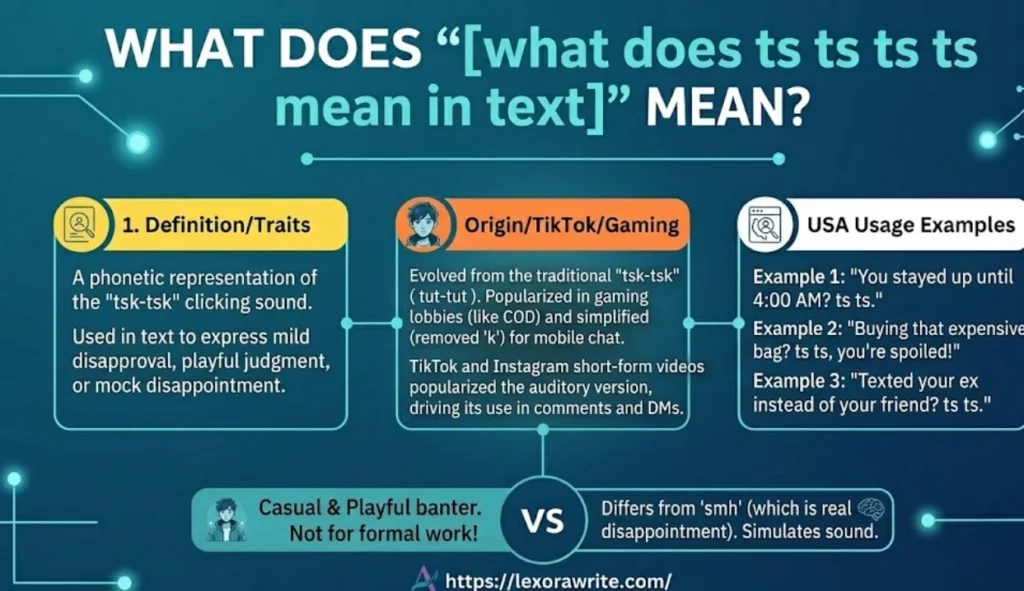
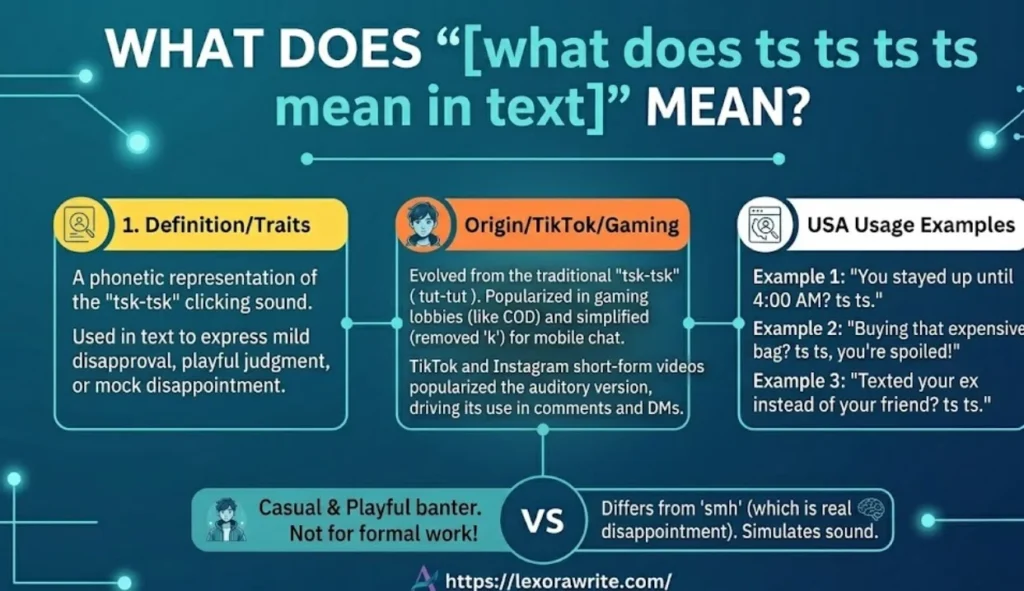
In text messaging and on social media, ts ts is the phonetic written version of the “tsk-tsk” tongue-clicking sound used to express mild disapproval, playful judgment, or lighthearted teasing. It essentially functions as a digital eye-roll or mock scolding between friends.
Why do people use ts ts instead of other slang?
Texting spaces favor this phonetic expression for its unique communicative benefits:
- Instant Auditory Vibe: It translates a physical, vocal gesture into a screen format so the recipient can instantly “hear” the sender’s reaction.
- Safer Than Text: It replaces harsh phrases with an implied digital tut-tut or playful eye-roll, keeping the tone safe, casual, and free of actual conflict.
- Shorthand Efficiency: It provides an efficient micro-expression that acts as an active call-out rather than the passive disappointment of terms like “smh.”
TS TS – Quick Meaning
At its core, “ts ts” is all about attitude. It translates a physical, vocal gesture into a text format so the recipient can “hear” the sender’s reaction.
- Primary Meaning: Disapproval, judgment, or mild scolding.
- Secondary Vibe: Playful teasing, flirting, or mock disappointment.
- The Sound: It mimics the noise you make when you press your tongue against the roof of your mouth and suck inward.
“You really stayed up until 4:00 AM watching anime again? ts ts”
“Oh, so you’re going to the beach without inviting me? ts ts, see how you are.”
“ts ts… I expected better from a coffee connoisseur.”
Origin & Background
While “ts ts” feels completely native to the smartphones of 2026, its roots go back way before the internet. It is the direct descendant of the traditional English word “tsk-tsk,” an onomatopoeia used in literature for over a century to denote a tutting sound. Historically, British and American English speakers used “tut-tut” or “tsk-tsk” in print to show moral disapproval.
The transformation into “ts ts” happened as mobile communication demanded shorter, faster ways to convey emotion. Gaming lobbies and early Twitter spaces started stripping away the “k” to make the typing experience seamless. Then came TikTok and Instagram Reels.
As short-form video content exploded, creators began using the literal vocal sound as an audio cue during storytimes or reaction videos. Gen Z and Gen Alpha users took that audio cue and brought it back into text form as “ts ts”. Today, it is deeply embedded in American youth slang, used to instantly set a judgmental or teasing tone without writing out a full sentence.
Real-Life Conversations
Seeing this slang in action is the easiest way to understand its fluid nature. Here is how “ts ts” plays out across different digital platforms in the USA.
WhatsApp Message
Chris: Hey, did you finish editing that video layout for the launch?
Brandon: Uhhh, I got sidetrxcked playing the new Call of Duty expansion lol. I’ll do it right now.
Chris: ts ts
Chris: Bro, the deadline is literally tomorrow morning.
Instagram DM
Hailey: Look at this massive slice of red velvet cake I just ordered at midnight.
Maya: ts ts
Maya: And here you were talking about your clean eating goals on your story three hours ago!
Hailey: Listen, the cake called my name, I had no choice.
TikTok Comments
User_Alex99: Am I the only one who skips the intro of this show every single time?
Content_Creator: ts ts
Content_Creator: The animator spent six months on that intro, show some respect!
Text Messages
Taylor: I might have accidentally texted my ex instead of my roommate.
Jordan: ts ts
Jordan: Rule number one of a breakup: delete the contact card immediately. What did you say?
Why is it Viral?
The sudden surge of “ts ts” in American digital spaces comes down to efficiency and emotional delivery. In a text-heavy world, we constantly lose vocal inflections and facial expressions. A simple sentence like “That is bad” can sound harsh or overly clinical.
Dropping a “ts ts” adds an immediate layer of personality. It is highly viral because it serves as an instant reaction meme in text form. It captures a universal human sound that crosses regional borders within the US, making it a highly efficient tool for micro-expressions.
Emotional & Psychological Meaning
Using “ts ts” is less about the literal letters and more about the psychological space it occupies. It allows the sender to establish a temporary position of moral or humorous authority. When someone types this to you, they are stepping into the role of a mock parent, a judging friend, or a playful referee.
Culturally, it reflects how modern Americans lean into low-stakes drama. We love to playfully call out our friends for their chaotic choices, lazy Sundays, or minor hypocrisies. It offers a way to say, “I see what you did there, and I am judging you just a little bit,” without causing actual conflict.
From personal experience, I remember a text from a colleague after I admitted to drinking a third energy drink before noon. She just replied: “ts ts.” It did not feel like a corporate scolding; it felt like a warm, humorous acknowledgment of my terrible lifestyle choices. That is the psychological sweet spot of the phrase—it creates connection through shared, lighthearted judgment.
Usage in Different Contexts
The meaning of “ts ts” shifts dramatically depending on the digital room you are standing in.
Social Media
On platforms like TikTok or X, “ts ts” is completely casual and public. It is used to react to trending drama, call out funny behavior in videos, or banter with creators in the comment sections. It is almost always lighthearted here.
Friends & Relationships
This is where the slang gets versatile. Between close friends, it is a tool for teasing. In romantic relationships, it frequently takes on a flirtatious tone. If you tell your partner you bought something expensive, a “ts ts” response is often a playful, affectionate way of calling you spoiled.
Work / Professional Settings
Be incredibly careful here. If you are using Slack, Microsoft Teams, or email, “ts ts” should generally be avoided. Because professional communication requires clear boundaries, a manager typing “ts ts” to an employee can easily come across as genuinely condescending, passive-aggressive, or deeply unprofessional.
Casual vs. Serious Tone
In a casual chat, it is a joke. However, if you are in the middle of a serious argument with someone and they hit you with a “ts ts,” they are likely using it to minimize your point or display genuine contempt. Context dictates whether it is a smile or a smirk.
When NOT to Use It
Language is a powerful tool, and timing is everything. Do not use “ts ts” when someone is sharing genuine grief, heavy personal struggles, or severe life updates. If a friend texts you saying they failed a crucial university exam or experienced a loss, replying with “ts ts” is incredibly insensitive.
Additionally, avoid using it with people who are not deeply immersed in internet culture. Older generations or non-native English speakers might interpret the letters literally or mistake them for a keyboard error, leading to unnecessary confusion. Keep it within circles where the digital shorthand is mutually understood.
Common Misunderstandings
The number one mistake people make with “ts ts” is reading it as a literal abbreviation for something else. Some assume it stands for “tough shit” or “top secret.” This misinterpretation can completely derail a conversation, turning a playful moment into a hostile exchange or a confusing riddle.
Another common point of confusion is the tone intensity. Because text lacks sound, some recipients view “ts ts” as severe criticism rather than a light, teasing gesture. Always look at the surrounding emojis and the history of your relationship with the person typing it to accurately gauge the temperature of the message.
Slang Comparison Table
To help you visualize exactly where “ts ts” sits in the modern lexicon, let us look at how it stacks up against similar and opposite digital expressions.
| Expression | Core Meaning | Tone Vibe | Usage Scenario |
| ts ts | Playful or mild disapproval | Teasing, light judgment | Reacting to a friend’s minor bad habit |
| smh (shaking my head) | Deep disappointment or frustration | Weary, annoyed | Reacting to genuinely foolish or sad news |
| fr (for real) | Agreement or validation | Earnest, supportive | Confirming that a situation is wild |
| bfr (be for real) | Calling out nonsense or denial | Blunt, confrontational | Telling someone to stop lying to themselves |
Key Insight
While “smh” conveys a sense of exhaustion or genuine disappointment with a situation, “ts ts” keeps things light, interactive, and performative. It acts as an active, auditory call-out rather than a passive expression of sadness.
Variations & Types
Depending on how many times the letters are repeated or how they are stylized, the intensity changes.
- ts: A singular, sharp point of punctuation. Often used as an abrupt “really?”
- ts ts: The standard, baseline version. Balanced, rhythmic, and clear in its playful tutting.
- ts ts ts: Escalated judgment. Adding a third unit implies you are leaning heavily into the bit.
- ts-ts: The hyphenated version. Feels a bit more deliberate, mimicking older literary styles.
- TSTS: All caps indicates loud, dramatic, theatrical shock or exaggerated public shame.
- ts…: The trailing ellipsis introduces a sense of speechlessness or mocking disbelief.
- tststst: A rapid-fire burst of clicks, usually indicating chaotic amusement at someone’s wild behavior.
How to Respond When Someone Uses It
When you find yourself on the receiving end of a “ts ts,” your reply should match the established energy.
Casual Replies
- “Hey, don’t judge me!”
- “My bad, my bad haha.”
- “Look the other way this once!”
Funny Replies
- “Guilty as charged 👑”
- “You love my chaotic energy, stop acting surprised.”
- “Don’t tsk-tsk me through a screen, say it to my face!”
Mature Replies
- “Yeah, I dropped the ball on that one. Fixing it now.”
- “Fair point, I need to get my act together.”
Respectful Replies
- “Understood, I will ensure it doesn’t happen again.”
Regional & Cultural Usage
The phonetic concept of the tongue-click is universal, but its text execution varies significantly across different cultural landscapes.
Western Culture
In the United States and Western Europe, “ts ts” is primarily a peer-to-peer digital tool. It is deeply tied to internet fluency and the democratization of slang through social platforms. It values irony and casual banter.
Asian Culture
In several East Asian cultures, vocal clicking sounds can carry much heavier weight, sometimes signifying deep frustration or respect-related boundaries. However, the younger generation in places like South Korea or the Philippines uses global internet variants seamlessly when speaking with Western friends online.
Middle Eastern Culture
In many Middle Eastern communities, a single upward click of the tongue (often written phonetically or expressed in person) means a direct, firm “No.” It carries an authoritative weight that is far more absolute than the playful American texting variant.
Global Internet Usage
Across global gaming servers and international discord channels, “ts ts” has become a universally understood piece of micro-slang. It bypasses language barriers because almost every culture recognizes the sonic root of the gesture.
Generational Differences
For Millennials, “smh” remains the old faithful for expressing disbelief. Gen Z and Gen Alpha, however, prefer the vocal, theatrical immediacy of “ts ts.” Older generations are highly likely to miss the auditory reference entirely, viewing the text as a spelling error.
Is It Safe for Kids?
Yes, “ts ts” is entirely safe for children to use and encounter online. It contains no hidden profanity, explicit meanings, or malicious undertones. It is a completely clean, expressive piece of punctuation-based slang that allows kids to communicate attitude safely without resorting to aggressive language.
FAQs
Is “ts ts” an acronym for something?
No, it is not an acronym. It is an onomatopoeia, meaning it is a written word that mimics a real-world physical sound—specifically the clicking noise made with the tongue to show disapproval.
What is the difference between “ts ts” and “smh”?
“Smh” stands for “shaking my head” and usually implies genuine disappointment, exhaustion, or frustration. “Ts ts” mimics the tutting sound and is far more playful, interactive, and lighthearted.
Can I use “ts ts” in a professional email?
It is highly recommended to avoid using this slang in professional emails. The lack of context can make it look unprofessional, confusing, or passive-aggressive to a colleague or client.
How do you pronounce “ts ts” when reading a text?
You do not pronounce the letters individually as “tee-ess tee-ess.” Instead, your brain reads it as the physical “tsk-tsk” or “tut-tut” tongue-clicking sound.
Why do people use “ts” instead of the full “ts ts”?
A single “ts” is just a shorter, sharper version of the slang. It acts as a quick exclamation of annoyance or surprise, like a verbal jab, whereas the double version is more rhythmic and teasing.
Final Thought
Navigating the landscape of modern digital communication can occasionally feel like learning a completely new language. Slang terms like “ts ts” showcase how creative we are as humans—we will literally invent new ways to push physical sounds through glass screens just to make sure our friends feel our true energy.
The next time someone sends you a “ts ts” after you admit to a late-night online shopping spree or a missed gym session, smile. They aren’t casting you out; they are inviting you into a moment of playful connection. For more deep dives into how language, culture, and communication intersect in our modern world, feel free to explore the resources over at Lexora Write, your home for contemporary insights. If you want a deeper look into the history of linguistic changes in the digital age, you can check out standard academic overviews on the evolution of internet linguistics. Go ahead and use your newfound slang knowledge confidently—just try not to earn too many tongue-clicks from your friends this week.