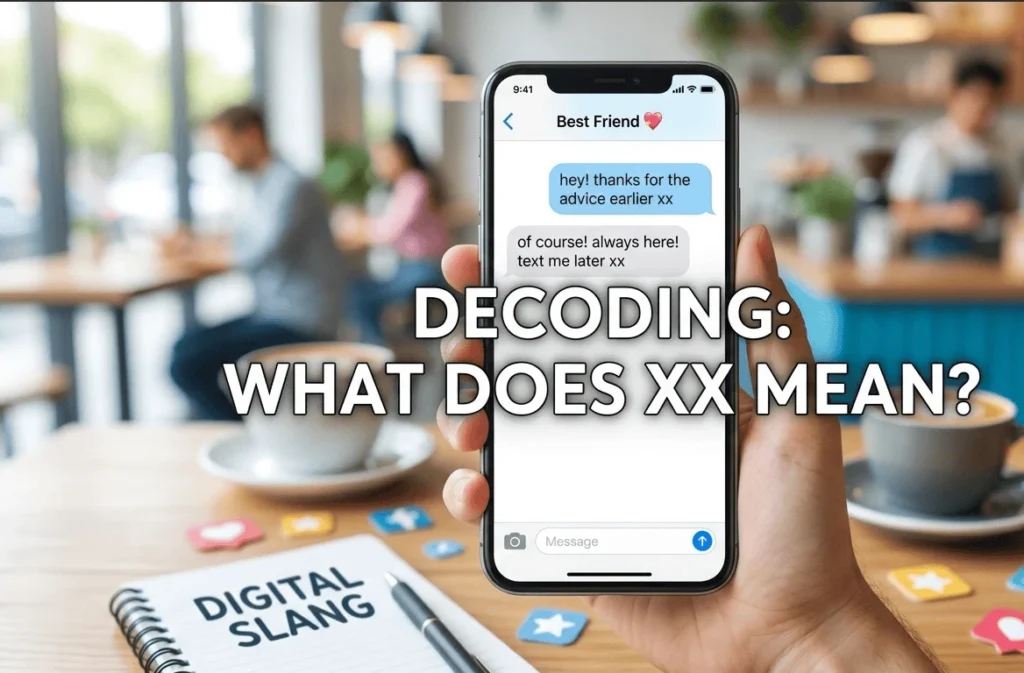
Decoding the Mysteries Behind the Double X Text
Have you ever looked down at your phone, read a message from a friend, partner, or colleague, and noticed a simple “xx” tacked on at the very end? You might pause for a moment, wondering whether it signifies a romantic gesture, a polite sign-off, or just a habit someone developed over years of typing.
Millions of people type queries like whats xx mean into search engines every single day because digital shorthand often lacks tone of voice, facial expressions, and body language. A single pair of letters can leave you feeling confused, overthinking the sender’s underlying motives or emotional state.
By understanding the exact nuances of this popular sign-off, you can instantly eliminate text anxiety, read between the lines accurately, and reply with absolute confidence across any messaging platform.
What Does XX Mean? – Quick Meaning
Core Definition and Basics
What Does XX Stand For?
In modern text communication, xx almost universally stands for two kisses. It is a warm, informal sign-off used to show affection, friendliness, closeness, or general warmth toward the recipient.
While a single “x” represents one kiss, doubling it up to “xx” amplifies the warmth without necessarily crossing into deep romantic territory. It acts as a gentle digital hug at the end of a thought.
Essential Elements of XX
- Primary Function: A friendly, affectionate closing sign-off in text messages and chat apps.
- Symbolic Representation: The letter ‘X’ visually mimics the shape of two lips puckering or two people embracing.
- Emotional Weight: Soft, friendly, caring, and lighthearted.
“Thanks for helping me move that couch today, you’re a lifesaver! xx”
“Let me know when you get home safely xx”
“See you at the coffee shop in twenty minutes xx”
Origin & Background
Historical Roots of the Kiss Symbol
Where Did the X Symbol Originate?
The habit of using an ‘X’ to represent a kiss dates back centuries before smartphones or the internet existed. Medieval monks and literacy-challenged individuals would sign legal documents or religious manuscripts with an ‘X’ to represent the Christian cross, swearing an oath of truth.
To show devotion and sincerity, the signer would physically kiss the parchment right over the ‘X’ mark. Over several generations, the physical act of kissing the written mark transformed into the symbol itself representing the kiss.
The Shift to Modern Digital Culture
When text messaging first emerged in the late 1990s and early 2000s, character limits were strict and expensive. People naturally adopted shorthand to convey emotional warmth quickly without spending extra precious character space.
Social media platforms like BlackBerry Messenger, MSN Messenger, and later WhatsApp cemented “xx” as a standard punctuation mark for emotional connection. It rapidly evolved from an archaic legal oath into a staple of modern digital intimacy.
Real-Life Conversations
WhatsApp Chat: Friends Planning an Evening
Person A: Hey! Are we still on for dinner tonight at 7?
Person B: Yes, absolutely! Just finishing up some work and then heading out. Can’t wait to catch up xx
Person A: Perfect, see you soon xx!
Instagram DMs: A Supportive Comment
Person A: Honestly had such a rough day at work today, feeling super drained.
Person B: Oh no, I’m so sorry to hear that! Drink some water and get some rest. I’m always here if you need to vent xx
TikTok Comments: Casual Creator Interaction
Person A: Loved your tutorial on sourdough bread! It turned out so fluffy!
Person B: Ah thank you so much for watching and trying it out! xx
iMessage Text: Family Connection
Person A: Don’t forget your aunt’s birthday dinner tomorrow night at Mom’s house.
Person B: Thanks for the reminder! I’ll bring the dessert xx
Emotional & Psychological Meaning
What XX Communicates Below the Surface
When someone appends “xx” to their text, they are sending a psychological signal of safety and low tension. In text-based communication, plain sentences can often sound harsh or overly formal; adding “xx” softens the visual tone instantly.
It expresses a desire to maintain a positive, warm rapport. The sender wants to ensure their words are interpreted with kindness rather than cold neutrality.
Human Psychology Behind Digital Affection
Humans naturally seek social connection and validation in every interaction. Using “xx” acts as a micro-reassurance that the connection remains strong, positive, and conflict-free.
Personal Reflection from Experience
During my early years analyzing interpersonal communication, I noticed a distinct shift in how people reacted to basic messages. I once received a text from a close friend that simply said, “Call me when you get this.” My heart rate spiked, expecting bad news.
A few minutes later, she sent a follow-up text: “Forgot to add xx!” That tiny addition instantly dissolved my anxiety, highlighting how powerful two small letters are in shaping our emotional perception.
Usage in Different Contexts
Social Media Platforms
On apps like Instagram, TikTok, and X (formerly Twitter), “xx” is routinely added to public comments and private direct messages. It signals friendly support, admiration, or polite appreciation between creators and followers.
Friends & Romantic Relationships
Among close friends, “xx” is almost second nature—a standard sign-off that means “I care about you.” In romantic relationships, it serves as a gentle daily reminder of affection, often escalating to “xxx” or “xxxx” depending on the level of passion.
Work and Professional Settings
Generally speaking, “xx” should be omitted from professional emails, Slack channels, and corporate communications. However, in modern creative industries or friendly workplace environments, long-term colleagues might occasionally use it to soften casual internal messages.
Casual vs. Serious Tone
Casual Context: “Thanks for picking up milk! xx” — Warm, breezy, and pleasant.
Serious Context: “I am so sorry for your loss. Thinking of you and sending so much love xx” — Empathic, deep, and comforting.
When NOT to Use It
Misleading Professional Scenarios
Never include “xx” in job applications, formal client communications, or emails to supervisors. Doing so can be perceived as unprofessional, overly familiar, or boundary-crossing.
Delicate or Serious Disputes
During an argument or a tense discussion, throwing in an “xx” can come across as passive-aggressive, sarcastic, or dismissive of the other person’s feelings.
Setting Clear Boundaries
If you are texting someone who has unrequited romantic feelings for you, consistently using “xx” can send mixed signals. It is better to stick to plain text to maintain clear boundaries.
Common Misunderstandings
Overthinking the Romantic Intent
The single biggest mistake people make when analyzing “xx” is assuming it always implies romantic interest. In many countries, particularly the UK and Australia, “xx” is simply a polite sign-off used with almost everyone, from your grandmother to your local barista.
Confusing Tone with Sarcasm
While rare, if “xx” is attached to a sharp statement—like “Fine, do whatever you want xx”—it transforms into passive-aggressive sarcasm. Always pay attention to the main sentence preceding the kisses.
Literal vs. Figurative Interpretation
Nobody expects you to physically kiss them twice when they send “xx.” It is a figurative gesture of digital warmth, not a literal promise of physical intimacy.
Comparison Table
| Term / Slang | Primary Meaning | Emotional Tone | Best Context |
|---|---|---|---|
| xx | Two kisses / Digital warmth | Warm, friendly, light | Friends, family, partners |
| xoxo | Hugs and kisses | Romantic, cozy, traditional | Partners, close loved ones |
| xo | Hug and kiss | Casual affection | Quick friendly sign-off |
| xxx | Three kisses / Extra affection | Passionate, highly affectionate | Romantic partners |
| lmao | Laughing my head off | Humorous, casual | Jokes, funny stories |
| BRB | Be right back | Informational, neutral | Quick status update |
Key Insight
While “xoxo” combines both physical hugs (O) and kisses (X), the modern “xx” sign-off strips away the formal layout to offer a streamlined, subtle layer of everyday warmth that fits seamlessly into modern text messaging.
Variations & Types
1. Single “x”
Meaning: A quick, polite kiss.
Explanation: Used for light, friendly sign-offs without coming on too strong.
2. Double “xx”
Meaning: Standard warm sign-off.
Explanation: The most common variation for daily friend-to-friend or partner communication.
3. Triple “xxx”
Meaning: Strong affection or passion.
Explanation: Typically reserved for romantic partners or extremely close family members.
4. Quadruple “xxxx”
Meaning: Overwhelming love or excitement.
Explanation: Sent during big celebrations, intense emotional moments, or deep affection.
5. Capitalized “XX”
Meaning: Loud or playful affection.
Explanation: Indicates high energy or emphasis on the emotional closing.
6. Spaced “x x”
Meaning: Casual, relaxed closeness.
Explanation: A slightly slower typing style that feels relaxed and informal.
7. Combo “xxo”
Meaning: Kisses and a hug.
Explanation: A modern variation prioritizing kisses while keeping a touch of hug-based support.
8. Punctuation Combo “xx!”
Meaning: Excited friendliness.
Explanation: Shows high enthusiasm alongside warm affection.
9. Question Sign-off “xx?”
Meaning: Softened inquiry.
Explanation: Used at the end of a question to make it sound non-demanding or sweet.
How to Respond When Someone Uses It
Casual Replies
- “Thanks so much! Talk to you later xx”
- “Sounds like a plan! See you soon.”
- “Appreciate it! Have a great day xx”
Funny Replies
- “Double kisses? I feel honored today!”
- “Sending back at least three kisses to win this exchange: xxx”
- “Keep those kisses coming, my day just got 10x better!”
Mature Replies
- “Thank you for the warm words, it truly means a lot to me.”
- “I really appreciate your support right now.”
- “Glad we could clear that up, take care!”
Respectful Replies
- “Thank you! Wishing you a wonderful weekend as well.”
- “Received with thanks! Have a fantastic evening.”
- “Much appreciated, speak to you soon.”
Regional & Cultural Usage
Western Culture (UK, Australia, New Zealand)
In British, Australian, and Kiwi texting culture, sending “xx” is as common as saying “please” or “thank you.” It is routinely used between friends, acquaintances, and family members without any romantic connotation whatsoever.
North American Culture (US & Canada)
In North America, people tend to reserve “xx” or “xoxo” more specifically for family members, close friends, or romantic partners. Receiving “xx” from a acquaintance in the US might be interpreted as slightly more meaningful than it would be in London.
Asian & Middle Eastern Cultures
In many Asian and Middle Eastern cultures, text messaging relies heavily on emojis, stickers, and dedicated kaomoji symbols rather than traditional letter-based kiss marks. However, global internet slang has made “xx” widely recognized among younger demographics.
Generational Differences (Gen Z vs. Millennials)
Millennials were instrumental in popularizing “xx” during the peak of SMS messaging. Gen Z often prefers using specific emojis—like the skull emoji for laughter or the heart-hands emoji for love—though they still recognize and use “xx” when communicating warmly. For more insights on digital slang and terms, check out Name Meaning Zone to explore modern names, linguistic terms, and cultural communication trends.
Is It Safe for Kids?
Yes, “xx” is entirely safe for children and teenagers to use and read. It carries no inherently explicit, inappropriate, or harmful double meanings in digital slang.
Parents can rest assured that “xx” simply functions as a friendly digital kiss or warm sign-off between peers and family members. Context always matters, but the shorthand itself is completely harmless.
FAQs
What does xx mean from a girl in a text message?
When a girl texts “xx,” it usually indicates warmth, friendliness, and comfort. While it can mean she likes you, it is extremely common for girls to send “xx” to friends, family, and acquaintances purely out of politeness and habitual warmth.
What does xx mean from a guy?
If a guy sends “xx,” he is making a conscious effort to soften his message and show affection or genuine friendliness. Since many men use shorthand less habitually, it often signifies that he truly values the connection or feels comfortable with you.
Is xx romantic or just friendly?
It can be both! Context is the key decider. In places like the UK, it is almost always purely friendly. In other regions, or when combined with flirtatious dialogue, it can carry romantic undertones.
What is the difference between x and xx?
A single “x” is a light, quick gesture of politeness or mild warmth. The double “xx” adds an extra layer of genuine care, affection, and emotional warmth to the message closing.
Can you use xx in business emails?
It is best to avoid using “xx” in professional or corporate emails. Stick to traditional sign-offs like “Best regards,” “Thanks,” or “Sincerely” to maintain clear professional boundaries.
What does xx mean on WhatsApp status or Instagram captions?
In social media captions, “xx” is used to send love to all followers or viewers at once. It acts as a general sign-off expressing gratitude and goodwill to the audience reading the post.
Final Thoughts
Text messaging has completely revolutionized how we share emotion, bridge physical distances, and build relationships. While navigating modern digital shorthand like “xx” can occasionally feel confusing, understanding its roots and context removes all the guesswork.
The next time those two little letters pop up on your screen, don’t stress over complex hidden meanings. Embrace the warmth, read the room, and send back a reply that feels true to your personal style.
To dive deeper into language origins and linguistic history, you can explore the detailed history of written communication on Britannica’s Alphabet & Writing Systems Guide.