
Have you ever been scrolling through your favorite social media app or chatting with someone new, only to stumble upon a three-letter acronym that completely derails your train of thought? You are definitely not alone. The digital landscape shifts rapidly, and keeping up with the shorthand can feel like trying to learn an entirely new language over the course of a single weekend.
One of the most frequent culprits of this modern communication confusion is the term “asl.” Depending on who is typing it, where they are posting it, and the overall vibe of the conversation, this tiny word can carry drastically different meanings. Misunderstanding it can lead to some incredibly awkward exchanges, which is exactly why we are breaking it down today.
Understanding the nuance behind modern text slang is about more than just keeping up with the kids; it is about genuinely connecting with people across different digital spaces. Let’s dive deep into what this popular acronym really means, where it originated, and how you can navigate using it like a seasoned digital native.
Decoding the Digital Shorthand: What Does ASL Mean in Text?
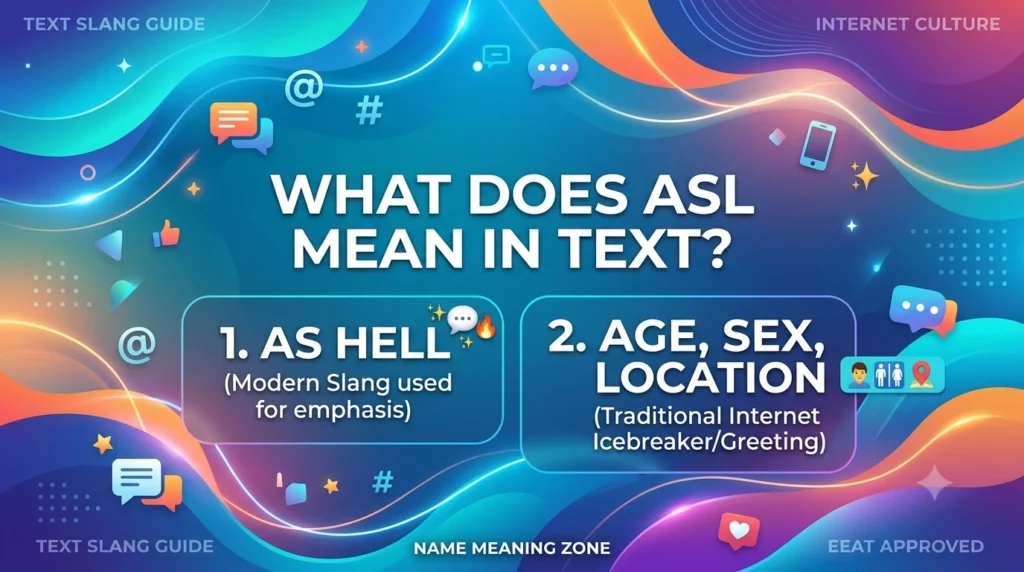
When you spot this acronym in a direct message or a comment section today, it almost always serves one of two completely distinct purposes. The meaning depends entirely on the age of the person you are chatting with and the platform you are currently using.
The Modern Meaning: “As Hell”
In contemporary internet culture, particularly among Gen Z and younger Millennials, the term is used as an intensive modifier. It functions as a phonetic, compressed version of the phrase “as hell.” When someone types it this way, they are trying to add emphasis or emotional weight to an adjective.
The Nostalgic Meaning: “Age, Sex, Location”
If you grew up during the early days of the internet, your mind probably jumps to a very different definition. In the era of AOL Instant Messenger (AIM), mIRC, and early internet chat rooms, this was the ultimate icebreaker. It was a quick, standardized way to ask an anonymous stranger for their basic demographic details: how old they were, their gender identity, and where they were logging in from in the world.
“That exam was difficult asl.” (Meaning: That exam was incredibly difficult.)
“He is funny asl, I can’t stop laughing at his videos!” (Meaning: He is extremely funny.)
“Hey there, asl? Just joined this group chat.” (Meaning: Hey, what is your age, sex, and location?)
The Fascinating Origin and Cultural Evolution of ASL
To truly appreciate how we use this term today, we have to look back at how digital communication has evolved over the last few decades. The internet has a beautiful way of recycling old language and giving it a completely fresh twist for a new generation of users.
The Cyber Icebreaker of the 1990s and 2000s
Back when the internet was a text-only frontier filled with anonymous chat rooms, knowing who you were talking to was a major challenge. Users needed a rapid-fire way to screen their conversation partners. The phrase “Age, Sex, Location” quickly became a cultural staple of early web forums. It was considered the universal greeting of the early web, used by millions to establish context before starting a deeper conversation.
The Rise of African American Vernacular English (AAVE) and TikTok
As the old chat room culture faded into the background, the acronym underwent a massive linguistic shift. The modern usage as “as hell” is deeply rooted in African American Vernacular English (AAVE), where dropping the “h” sound in speech naturally blends the words “as” and “hell” together into a single, seamless phrase.
With the explosive rise of platforms like Twitter, TikTok, and Instagram, this spoken cadence found its way into typed text. Younger internet users adopted the shorthand to save space, increase typing speed, and match the rhythmic flow of how they actually talk in real life. Today, it has completely taken over the comment sections of viral videos worldwide.
Real-Life Conversations: ASL in the Wild
Seeing this slang used in real-life contexts is the quickest way to master its subtle shifts in tone. Let’s look at how people actually interact with this term across different platforms today.
- Person MAX : Did you see the new sneakers that dropped this morning?
- Person JONI : Yeah, they look clean asl but the price tag is absolutely wild.
- Person MAX : For real, I might have to pass on them this time.
- User 1: The plot twist at the end of this movie had me confused asl 💀
- User 2: Right?! I had to rewind it twice just to figure out what happened to the main character.
Scenario : A Retro Gaming Discord Server
- New Member: Hey everyone, just joined the server! Excited to talk about old retro games.
- Moderator: Welcome to the community! Standard intro question for the new folks: asl?
- New Member: Ah, gotcha! 28, Male, Chicago. Glad to be here!
Scenario : A Casual WhatsApp Text Group
- Sarah: Are we still meeting up for dinner tonight or is everyone too tired?
- Mike: I am down, but I am hungry asl right now so we need to order fast.
- Sarah: Same here, let’s meet at the diner in twenty minutes.
The Emotional and Psychological Weight Behind the Slang
Text messaging is inherently flat; it completely lacks the vocal inflections, facial expressions, and body language that make face-to-face communication so rich. Because of this, slang words often step in to fill the emotional void, acting as digital punctuation marks that convey our inner feelings.
Using the modern version of this term signals a desire for closeness, casual comfort, and shared cultural understanding. It tells the reader that the speaker is relaxed, expressive, and unpretentious. By transforming a standard adjective into something highly emphasized, the speaker invites the reader to share in their heightened emotional state, whether that state is pure joy, absolute exhaustion, or complete shock.
A Personal Perspective on Digital Shifting
I remember chatting with a younger cousin of mine a few months ago. He sent me a message saying he was “tired asl” after a long soccer practice. For a split second, my old-school internet brain panicked, wondering why he was sending me his demographic data out of nowhere. Once I realized he just meant he was completely exhausted, we both had a massive laugh. It made me realize just how deeply text slang can alter our daily interactions based on our age and background.
Navigating Different Contexts: When and Where to Use It
Like any piece of informal language, timing and environment are everything. Using this slang in the wrong setting can create massive misunderstandings or make you look highly unprofessional.
Social Media Platforms
On apps like TikTok, Instagram, Twitter, and Snapchat, the modern intensive version reigns supreme. It fits perfectly into brief captions, quick comments, and rapid-fire video responses. It matches the high-energy, fast-moving nature of these specific spaces.
Friends and Relationships
Among close friends, peers, and romantic partners, using this slang creates a sense of casual intimacy. It shows that you feel comfortable enough around the other person to drop formal grammar rules and speak freely.
Professional and Workplace Settings
This is where you need to exercise extreme caution. Sending a message to your boss saying you are “busy asl” is a massive misstep. It reads as highly unprofessional, overly familiar, and disrespectful of workplace boundaries. Stick to traditional, polished English when writing emails, Slack messages, or reports.
When NOT to Use It: Cultural and Situational Sensitivity
While text shorthand is incredibly fun to use, there are several scenarios where you should completely leave it out of your vocabulary to avoid causing confusion or offense.
Professional Correspondence
As mentioned above, professional communication requires an entirely different vocabulary. Using internet slang in a cover letter, corporate update, or client email can instantly damage your professional credibility.
Formal Educational Settings
When writing essays, contacting professors, or participating in academic forums, always choose standard grammatical structures.
Conversations with Elders
If you are texting an older relative who did not grow up around internet culture, using modern shorthand will likely cause massive confusion. They might mistake it for an error or spend twenty minutes trying to figure out what you are trying to say.
Linguistic Confusion with American Sign Language
It is incredibly important to remember that ASL is also the official, widely recognized capitalized acronym for American Sign Language. When discussing education, accessibility, disability rights, or linguistics, using the term carelessly can create deeply confusing or culturally insensitive situations. Always ensure your context makes it clear whether you are talking about a beautiful, living visual language or a quick piece of internet slang.
Common Misunderstandings and Pitfalls
The biggest point of confusion with this specific acronym lies in the massive generational divide between its two primary meanings.
If a Millennial or Gen X user asks “asl?” in an old-school forum or a retro gaming chat room, they are actively looking to find out who you are. If a Gen Z user sees that, they might assume the person is trying to say something is “as hell” but forgot to include an adjective before it. This literal vs. figurative divide can completely derail a conversation if neither party realizes they are using two entirely different dictionaries.
Internet Slang Comparison Table
To help you keep track of how this term stacks up against other popular pieces of internet shorthand, let’s look at a quick comparative breakdown.
| Slang Term | Primary Meaning | Emotional Tone | Common Platform |
|---|---|---|---|
| asl (Modern) | As hell (Emphasis) | Casual, high-energy | TikTok, Instagram |
| asl (Classic) | Age, sex, location | Informational, curious | Older chat rooms, Discord |
| af | As f*** (Extreme emphasis) | Intense, edgy | Text messages, Twitter |
| fr | For real (Agreement) | Sincere, validating | Snapchat, TikTok |
| rn | Right now | Immediate, urgent | WhatsApp, DMs |
| brb | Be right back | Informative, polite | Professional or casual chat |
Key Insight
While terms like “af” and modern “asl” both serve to emphasize a point, “asl” is often viewed as a slightly softer, more casual linguistic choice that flows naturally in everyday text conversations without feeling overly aggressive.
10 Common Variations and Related Expressions
Internet slang is incredibly versatile, often spawning dozens of variations that carry similar linguistic weights. Here are some of the most common expressions you will see alongside or in place of this acronym.
1. AF
- Meaning: As F***.
- An incredibly common, higher-intensity alternative used to add maximum emphasis to an adjective.
2. FR
- Meaning: For Real.
- Used to express deep sincerity, absolute agreement, or to ask if someone is being completely honest.
3. FRFR
- Meaning: For Real, For Real.
- A doubled-up version of the acronym used to emphasize that the speaker is being 100% serious.
4. Ong
- Meaning: On God.
- A popular modern phrase used to swear on something or to prove that you are telling the absolute truth.
5. No Cap
- Meaning: No Lie / Being Serious.
- Used to clarify that a statement is completely true and not an exaggeration or a joke.
6. Deadass
- Meaning: Completely Serious.
- A regional slang term turned global internet staple used to signal absolute earnestness.
7. Lowkey
- Meaning: Secretly / Moderately.
- Used when you want to admit to a feeling or thought without making it a massive deal.
8. Highkey
- Meaning: Openly / Extremely.
- The exact opposite of lowkey, used when you want to loudly and proudly declare a fact or feeling.
9. A$$ Hell
- Meaning: As Hell (Spelled out).
- The fully written-out phonetic version of the modern intensive acronym, used when the speaker wants to ensure there is zero ambiguity.
10. A/S/L
- Meaning: Age / Sex / Location (With slashes).
- The traditional structural formatting of the classic internet icebreaker, explicitly used to separate the demographic questions.
How to Respond When Someone Uses It
Your response should depend entirely on which version of the acronym the other person dropped into the conversation.
When Used as Emphasis (“As Hell”)
If a friend texts you that they are “happy asl” because they passed a test, you don’t need to overthink your reply. Simply match their positive energy and validate their feelings.
- Casual: “Let’s gooo! You absolutely deserved that win!”
- Funny: “Drop some of that good luck over here because I definitely need it!”
When Used as an Icebreaker (“Age, Sex, Location”)
If someone asks you this in an older chat space, they are looking for basic demographic info. You can choose how much you want to share based on your personal comfort levels.
- Mature: “I’m 26, female, based out of New York. How about you?”
- Respectful Alternative: “Hey! I prefer to keep my specific details private, but I’m happy to chat about the game here!”
Regional, Cultural, and Generational Differences
The way people perceive this acronym varies wildly depending on their geographical location and their generational roots.
Western Internet Culture
In the United States, Canada, and the United Kingdom, the modern version has been thoroughly integrated into youth culture. It appears seamlessly in mainstream music, viral social media trends, and everyday digital communication.
Global Internet Usage
In regions like Asia and the Middle East, English text slang is often adopted through the lens of global pop culture. Younger users who consume American media use the modern version frequently. However, older internet users in these regions may still associate the acronym primarily with its classic chat room roots.
The Generational Great Divide
The contrast between generations is truly fascinating here. Gen Z and Gen Alpha use the term naturally as an intensive modifier without a second thought. On the flip side, Millennials and Gen Xers instantly get a wave of early-2000s internet nostalgia when they see it, reminding them of desktop computers and dial-up internet sounds. For a fascinating look at how deeply names, words, and labels shape our cultural identity across generations, exploring resources like Name Meaning Zone can offer incredible insight into our evolving language.
Is It Safe for Kids and Teenagers?
For parents navigating the complex world of modern parenting, seeing unfamiliar acronyms on a child’s phone can be quite alarming. Fortunately, the modern version of this term is generally harmless. It is simply a stylized piece of emphasis used to express excitement, frustration, or humor.
However, parents should be aware of the older “Age, Sex, Location” meaning. If a child is using older web forums, unmoderated gaming lobbies, or anonymous chatting apps and encounters this acronym as a question, it means a stranger is actively asking for their personal demographic information. It is highly beneficial to talk to kids about the importance of digital privacy, reminding them to never share their age, gender, or real-world location with anyone online.
Frequently Asked Questions
Is using “asl” considered rude or inappropriate?
No, it is not inherently rude. In casual conversations among friends or on social media, it is viewed as a normal, high-energy way to emphasize a point. However, because it is incredibly informal and stems from a phrase containing mild profanity, you should absolutely avoid using it in professional, academic, or highly formal environments.
Does the acronym always refer to American Sign Language?
Context is everything here. When written in lowercase letters in a text message or a social media comment, it almost always means “as hell” or “age, sex, location.” When capitalized as “ASL” in an educational, medical, or cultural context, it refers directly to American Sign Language, which is a rich, structural visual language used by millions of people.
Why do people type it in lowercase?
In modern internet culture, typing entirely in lowercase is a deliberate stylistic choice. It gives messages a more relaxed, effortless, and casual aesthetic. Capitalizing internet slang can sometimes make a text feel overly loud or rigid.
Can I use this acronym in a work email if I am close with my coworker?
It is generally best to avoid it. Even if you share a friendly bond with a colleague, work communication channels can easily be audited or reviewed by management. Keeping your workplace communication clean and professional protects your career reputation.
How did “as hell” turn into “asl”?
The transition is entirely phonetic. In fast, casual speech, the phrase “as hell” often drops the breathing sound of the letter “H,” sounding exactly like “as-ell.” Over time, internet users simply dropped the middle vowels to create a rapid, three-letter text shortcut that perfectly mirrors that spoken rhythm.
Final Thoughts on the Evolution of Chat Language
Language is a beautiful, living entity that constantly reshapes itself to fit the needs of the people using it. The journey of this specific acronym—from a structural safety tool in the wild west of 90s chat rooms to a vibrant, emotional punctuation mark on modern social media—is a testament to how creative humans can be with our communication.
Embracing these shifts allows us to understand the digital world just a little bit better, keeping our online interactions clear, authentic, and fun. The next time you see someone post that they are happy or tired using this acronym, you can confidently join the conversation without missing a single beat!